10 Surprising Facts About Cars You Didn’t Know
You might not know that the term “dashboard” actually comes from horse-drawn carriages.
It’s fascinating how some habits from the past still linger in modern terminology.
And did you know that holding your key fob to your head can boost its signal like a natural amplifier?
Pretty cool, right?
When it comes to recycling, cars top the charts globally, with an impressive 27 million recycled each year.
It’s incredible how our vehicles can have such a positive impact on the environment.
Some car owners cherish their rides forever—one even owned a Rolls Royce for an astonishing 82 years!
That’s some serious loyalty to a vehicle.
Today, there are over a billion cars on the road worldwide, and Ford assembles an F-150 in just six hours.
Discover these and other astonishing car facts waiting for you!
Key Takeaways
– The term “dashboard” originated from horse-drawn carriages as a mudguard.
Before it became a car’s control panel, it served a different purpose entirely.
– The first car accident happened in 1891 when a vehicle hit a tree root.
This incident highlighted the early road safety needs that we still consider today.
– Holding a key fob to your head can amplify its signal.
This clever trick extends the unlocking range by leveraging the skull’s natural amplification.
– The world’s longest car ownership record is 82 years for a 1928 Rolls Royce.
This remarkable duration shows the deep emotional bonds that can form with vehicles.
– Ford assembles an F-150 in just six hours using advanced robotics.
This impressive feat combines speed with high-quality craftsmanship, making it a marvel of modern manufacturing.
The Origin of the Term “Dashboard”
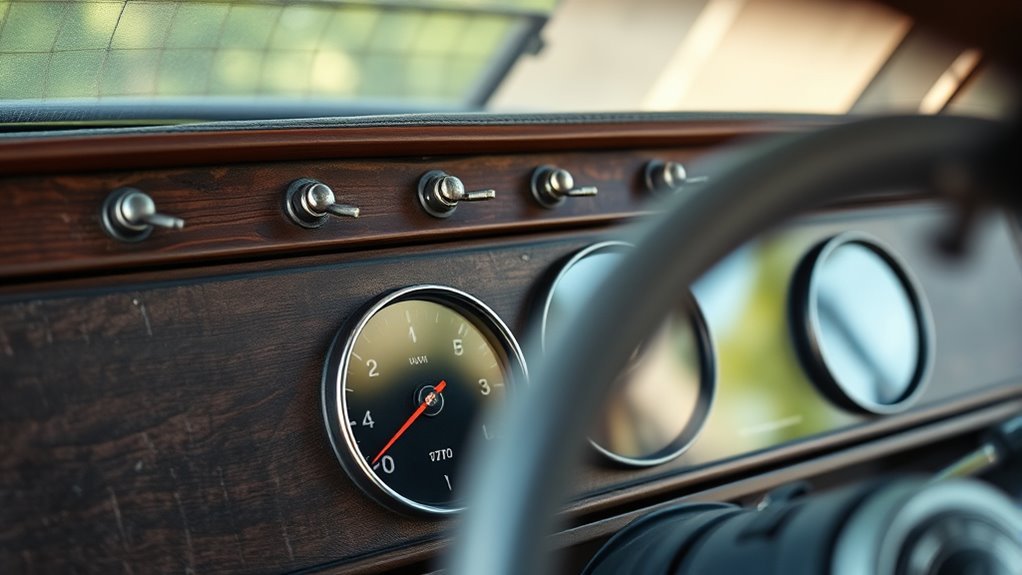
Although you might only associate the dashboard with modern cars, its name actually comes from horse-drawn carriages.
Back then, a wooden board was placed behind the horses to stop mud from splashing onto passengers.
As transportation evolved and automobiles replaced carriages, the dashboard transformed from a simple mudguard into a panel equipped with controls and instruments for drivers.
This shift highlights how early transportation influenced both the language and design elements in automotive design.
Even today, despite advances in technology and digital displays, the term dashboard remains a nod to its historical origins.
Understanding this connection gives you a glimpse into how automotive design carries the legacy of past transportation methods, linking the past and present in everyday driving experiences.
How Holding a Key Fob to Your Head Extends Its Range

Just as the dashboard connects modern cars to their past, some clever tricks link you more closely to your vehicle’s technology.
One surprising hack involves holding your key fob to your head to extend its range.
Hold your key fob to your head to cleverly boost its signal range and unlock your car from farther away.
Automotive enthusiasts swear by this signal enhancement technique, which works because your skull acts like a natural amplifier.
This can potentially double the fob’s reach, meaning you can access your car from farther away without being right next to it.
While the effectiveness varies depending on your key fob and vehicle model, many drivers have found success with this quirky tip.
It’s a simple, fun way to boost your key fob’s signal without any extra gadgets.
Proving that sometimes the best tech upgrades come from unexpected places.
The World’s Most Recycled Product: Cars
Millions of cars reach the end of their life each year, making them the most recycled product worldwide.
When you recycle a car, you’re part of a massive effort—around 27 million vehicles are processed annually, recovering metals, plastics, and glass from roughly 30,000 parts per car.
This recycling not only saves valuable resources but also cuts down on waste and reduces the environmental impact linked to producing new materials.
The automotive industry relies heavily on this process to promote sustainability, conserving raw materials and minimizing landfill contributions.
The Longest Recorded Car Ownership
Recycling cars extends their impact beyond their driving years, but some vehicles remain with their owners for decades, forging unique stories.
Take Allen Swift’s 82-year record for the longest duration of car ownership. He treasured a 1928 Rolls Royce Piccadilly-P1 Roadster, a graduation gift from his father.
The car originally cost $10,900, about $141,700 in 2010. Over the decades, Swift drove it regularly, building an impressive mileage total.
His commitment highlights how car ownership can create enduring connections that go beyond mere transportation.
When you think about it, such long-term loyalty shows the deep bond some people develop with their vehicles.
It really turns a simple car into a cherished piece of personal history.
The Surprising Number of Cars Worldwide
You might be surprised to learn there are about 1 billion cars on the road worldwide, with more cars than people.
Every day, manufacturers produce around 178,000 new vehicles to meet demand.
However, many of these cars go unsold and eventually get disposed of, shaping the constantly changing car market.
Global Car Population
Over one billion cars are currently in use worldwide, a number that actually surpasses the global human population.
This astonishing global car population reveals just how deeply cars influence daily life across the planet.
Here’s an interesting car fact: each vehicle contains about 30,000 parts, showcasing incredible engineering complexity.
Another surprising fact is that around 95% of retired cars get recycled, with roughly 27 million vehicles recycled yearly.
This helps reduce environmental impact.
These interesting facts highlight not only the scale but also the sustainability efforts within the automotive industry.
Daily Car Production
Although you might not realize it, the automotive industry produces an astonishing number of cars every day.
Globally, top manufacturers like Toyota and Honda contribute to a daily car production average that can reach up to 178,466 vehicles.
This interesting figure highlights the scale of the industry, given that in 2013 alone, over 65 million cars were made worldwide.
With more than 1 billion cars currently in use across the globe, the demand for new vehicles remains high.
Each car is a complex assembly of around 30,000 parts, showcasing the intricate manufacturing process behind daily car production.
Understanding these numbers gives you a clearer view of how vast and dynamic the car industry truly is on a global scale.
Unsold Vehicle Disposal
The automotive industry churns out millions of cars each year, but not all find their way to buyers.
Many unsold vehicles accumulate in lots or warehouses, impacting the automotive market’s supply dynamics.
With around 1 billion cars in use worldwide and over 65 million produced annually, the scale is massive.
Fortunately, about 27 million cars are recycled each year, making cars the most recycled product globally.
Since an average car contains roughly 30,000 parts, recycling promotes sustainability by recovering valuable materials.
When you consider how many cars go unsold, it’s clear that disposal through recycling plays an essential role in managing excess inventory and reducing waste.
The automotive market depends heavily on efficient handling of unsold vehicles and recycled cars to maintain balance and environmental responsibility.
What Makes the “New Car Smell”
When you step into a brand-new car, you often notice a distinctive scent that many find appealing.
Stepping into a brand-new car, you’re greeted by a distinctive scent that many find enticing.
This “new car smell” comes from volatile organic compounds (VOCs) released by materials like plastics, adhesives, and paints inside the vehicle.
Even luxury brands like Aston Martin aren’t exempt from this phenomenon.
These VOCs include chemicals such as formaldehyde, benzene, and toluene, which create that recognizable aroma but can pose health risks when inhaled.
Heat amplifies the release of these compounds, making the scent stronger, especially if the car is parked in the sun.
While the new car smell excites many buyers, it’s important to be aware that this fragrance results from chemical emissions rather than just fresh craftsmanship.
The Invention and Purpose of Cruise Control
If you’ve ever wished your car could maintain a steady speed without you having to keep your foot on the gas, cruise control is the feature that makes that possible.
Invented in 1948 by Ralph Teetor, this innovation was born from his frustration with inconsistent driving speeds while riding as a passenger.
Cruise control enhances your comfort by letting you relax during long drives, maintaining steady speeds effortlessly.
What started as a luxury feature has become standard in many cars today, improving fuel efficiency on highways.
Modern versions, called adaptive cruise control, use sensors to adjust your speed based on traffic ahead, further increasing convenience.
This remarkable innovation continues to transform driving, making your journeys smoother and less tiring.
A Car That Lasted Over 3 Million Miles
One car defied expectations by lasting over three million miles, driven by Irv Gordon for 47 years.
This 1966 Volvo P1800, a classic sports car, isn’t just any vehicle—it set a Guinness World Record for the highest mileage on a non-commercial car.
If you think sports cars are all about speed and short lifespans, this fact challenges that notion.
Gordon used the Volvo daily, proving that with proper maintenance, a car can achieve incredible durability.
This story highlights some fascinating car facts: longevity depends not just on engineering but also on the owner’s dedication.
Ford’s Efficient F-150 Assembly Line
You might be surprised to learn that Ford’s Dearborn plant can assemble an F-150 in just six hours.
This speed is possible because of advanced automation, like robots that install windshields with precision.
Understanding how automation speeds up the build process shows you the future of car manufacturing.
F-150 Build Time
While many trucks take days to assemble, Ford’s Dearborn plant can build an F-150 in just six hours.
This highlights the efficiency of their assembly line. You might be able to appreciate how this rapid build time doesn’t sacrifice quality.
Ford combines speed with precision, ensuring each truck meets high standards before leaving the factory.
Here’s what makes this possible:
- Advanced robotics like Bumper and Blinker install windshields with pinpoint accuracy.
- A streamlined process balances speed with craftsmanship throughout the assembly.
- The efficient build helps Ford meet the massive demand for one of North America’s best-selling trucks.
Thanks to these factors, you might be able to see why Ford’s F-150 production is both fast and reliable.
Automation in Assembly
Because Ford’s Dearborn plant uses advanced automation, it can build an F-150 in just six hours without compromising quality.
You’ll find robots like Bumper and Blinker expertly installing windshields, speeding up the process with precision.
This blend of automated tech and skilled labor keeps production both fast and reliable, ensuring each truck meets high standards.
Automation doesn’t just cut down time; it helps maintain consistent quality control, giving Ford a competitive edge.
As you see these innovations in action, it’s clear how modernization plays a crucial role in meeting growing consumer demand.
The First Recorded Automobile Accident
The first recorded automobile accident happened in 1891 in Ohio City, Ohio, when James William Lambert’s car struck a tree root.
This early mishap caused his vehicle to crash into a hitching post, marking a key moment in automotive history.
Luckily, Lambert only suffered minor injuries, reflecting the slow speeds of early cars.
This incident pushed for better road safety awareness and regulations as cars rapidly evolved.
Here’s what you need to know about this pioneering accident:
- It occurred just a few years after the automobile was invented.
- The crash highlighted the need for safety measures on public roads.
- It showed how quickly vehicle technology was advancing and its impact on society.
You can see how this early accident shaped the future of driving safety.
Frequently Asked Questions
What Are Some Interesting Facts About Cars?
You might not know that cars have about 30,000 parts.
Cruise control was invented in 1948, and 95% of retired cars get recycled.
Plus, dashboards once kept mud off carriage passengers!
Is There a 1 of 1 Car?
Yes, you can find a “1 of 1” car, like the McLaren P1 GTR, built uniquely for one customer.
These exclusive rides showcase custom designs, making them rare treasures that collectors highly covet and value.
What Color Car Is Least Stolen?
Like a beacon in a sea of shadows, yellow cars are least stolen.
You’ll find thieves avoid bright colors like gold and yellow, making your ride less tempting and safer than common black, white, or gray vehicles.
What if Cars Were Never Invented?
If cars were never invented, you’d rely heavily on walking, biking, and public transit.
Cities would be more pedestrian-friendly, air quality would improve,
and you’d see different hobbies and industries focused on alternative transportation methods.
Conclusion
Now that you’ve uncovered these mind-blowing car facts, you’re basically a walking automotive encyclopedia!
From dashboards to million-mile engines, cars are way more fascinating than you ever imagined.
Next time you hop in your ride, remember—you’re not just driving a machine; you’re cruising in a piece of history, science, and magic all rolled into one.
Who knew cars had so many secrets waiting for you to discover?
Buckle up, the journey’s just getting started!
As you absorb these surprising facts, let them enhance your appreciation for the intricate world of automobiles.
From their innovative designs to astonishing capabilities, cars are a testament to human ingenuity.
So, the next time you take a drive, think about all the incredible history and technology behind the wheel.
You’re not just in a vehicle; you’re part of a remarkable story that continues to unfold!