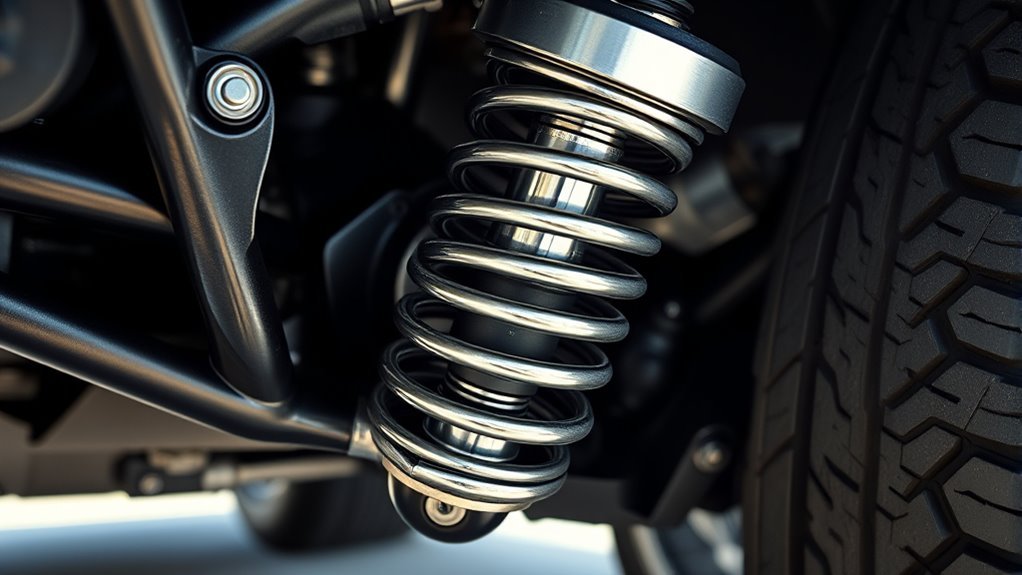
Key Parts of a Car Suspension System
Your car’s suspension system is crucial for a smooth and stable ride. It relies on key parts like springs, shock absorbers, and control arms.
Springs absorb bumps in the road, while shock absorbers manage the movement of these springs to prevent excessive bouncing.
Ball joints and knuckle arms play a vital role in steering and maintaining stability.
To enhance handling, stabilizer bars reduce body roll during turns. Strut bars also bolster suspension support for improved performance.
If you want to dive deeper into how these components work together, there’s plenty more to explore.
It’s fascinating how each part contributes to your overall driving experience!
Key Takeaways
– Springs absorb shocks and maintain vehicle stability by compressing and expanding over uneven surfaces.
They play a crucial role in providing a comfortable ride.
– Shock absorbers control spring movements to smooth out bumps and improve handling.
This helps ensure that the wheels stay in contact with the road.
– Ball joints and control arms connect wheels to the chassis, enabling steering and maintaining alignment.
These components are essential for responsive maneuvering.
– Stabilizer bars reduce body roll by evenly distributing weight during turns for enhanced stability.
This feature is key for a balanced driving experience.
– Strut bars connect strut towers to improve suspension support and high-speed handling performance.
They add rigidity, which is beneficial for sporty driving.
Springs
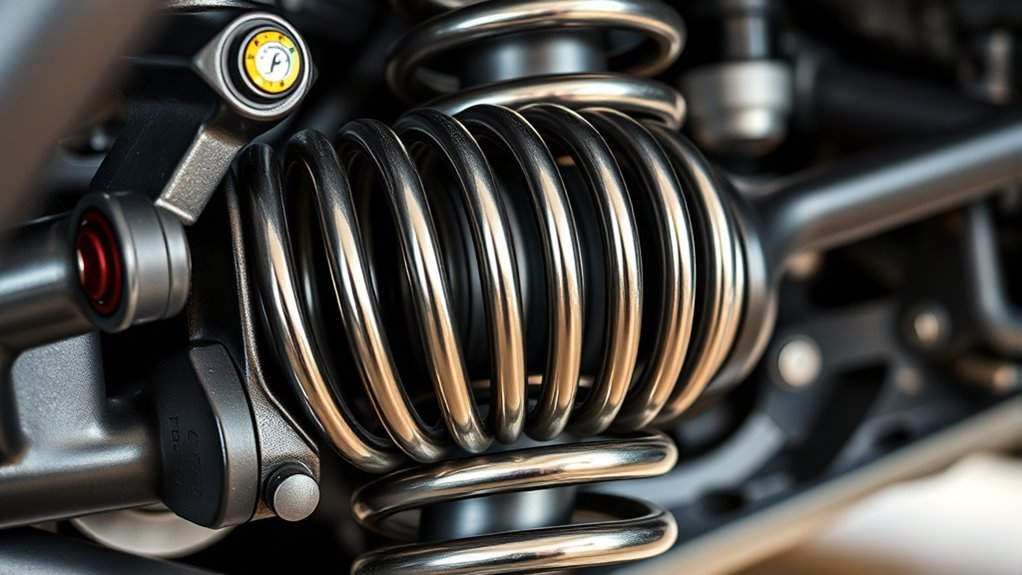
Springs play an essential role in your car’s suspension system by absorbing shocks from uneven roads and keeping your ride comfortable.
Within the vehicle’s suspension system, springs act as the primary components that cushion impacts, ensuring smooth handling.
Springs are key to cushioning impacts and maintaining smooth handling in your vehicle’s suspension system.
You’ll find coil springs in most modern cars because they compress and expand efficiently, providing a balanced, smooth ride.
Leaf springs, on the other hand, are typically used in trucks and larger vehicles, made of stacked metal strips that offer strength and stability.
While shock absorbers work alongside springs to control motion, it’s the springs themselves that bear the brunt of road irregularities.
Keeping your springs in good condition is crucial since worn or damaged springs can reduce your vehicle’s stability and cause excessive bouncing.
This can compromise your driving comfort and safety.
Shock Absorbers
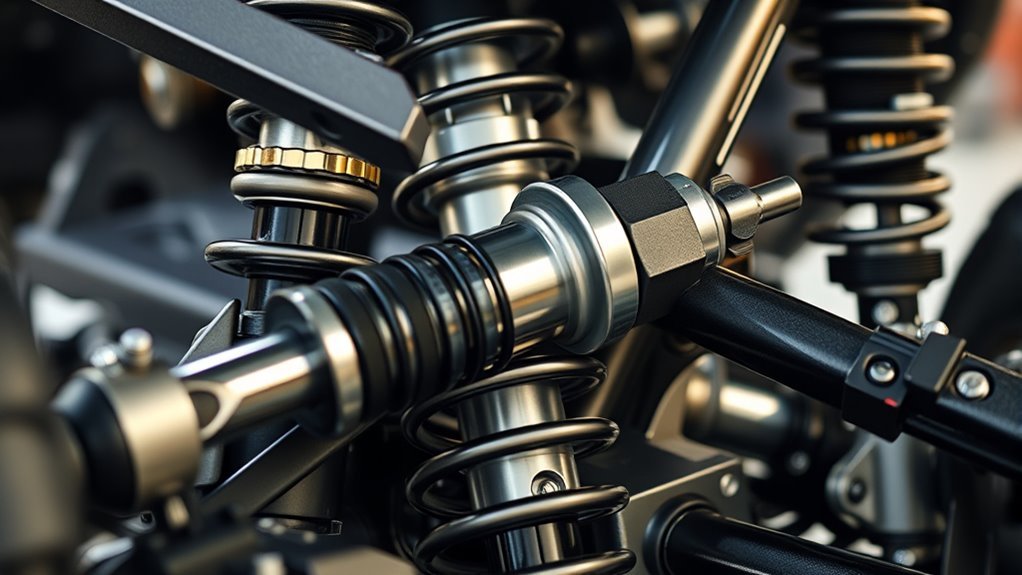
You rely on shock absorbers to smooth out bumps and keep your car stable by controlling spring movements.
Knowing the different types and designs helps you choose the right fit for your vehicle’s needs.
Don’t forget, regular maintenance and timely replacement are key to keeping your ride safe and comfortable.
Function and Purpose
A vehicle’s shock absorbers play an essential role in smoothing out your ride by controlling the up and down movements caused by uneven roads.
As key suspension components, shock absorbers absorb the impact from bumps and potholes, preventing the springs from causing excessive bouncing.
They compress and expand fluid inside a cylinder to dampen oscillations, converting kinetic energy into heat.
This function keeps your car balanced and stable, guaranteeing better handling and control.
Without properly working shock absorbers, your vehicle’s suspension system can’t effectively manage road irregularities, compromising safety and comfort.
Types and Designs
Shock absorbers come in different types and designs, each tailored to manage your vehicle’s movements in specific ways.
In a car suspension system, shock absorbers play a key role among various parts by dampening spring-induced motions.
You’ll find two main types: single-acting, which control movement in one direction, and double-acting, which handle both upward and downward motions.
Their unique design varies from twin-tube to monotube configurations, with gas or hydraulic operation influencing performance.
These designs suit different types of suspension systems, balancing comfort and control.
Inside, fluid resistance absorbs shocks during compression and expansion, smoothing your ride.
Understanding these types and designs helps you appreciate how shock absorbers contribute to your vehicle’s handling and stability.
Maintenance and Replacement
Because worn shock absorbers reduce handling and increase braking distances, you should inspect them regularly to keep your vehicle safe and comfortable.
During shock maintenance, check for leaks, dents, or unusual wear that can compromise performance.
Since shock absorbers typically last between 50,000 and 100,000 miles, timely replacement is essential.
When it’s time to replace these parts, always swap them in pairs—front or rear—to maintain balanced control and consistent ride quality.
Don’t overlook other suspension components like control arms during your inspection, as they work closely with shocks for proper vehicle stability.
Using genuine shock absorbers guarantees correct fit and function, avoiding the risks counterfeit parts pose to ride comfort and safety.
Regular attention to these parts keeps your suspension system working smoothly.
Ball Joints and Knuckle Arms
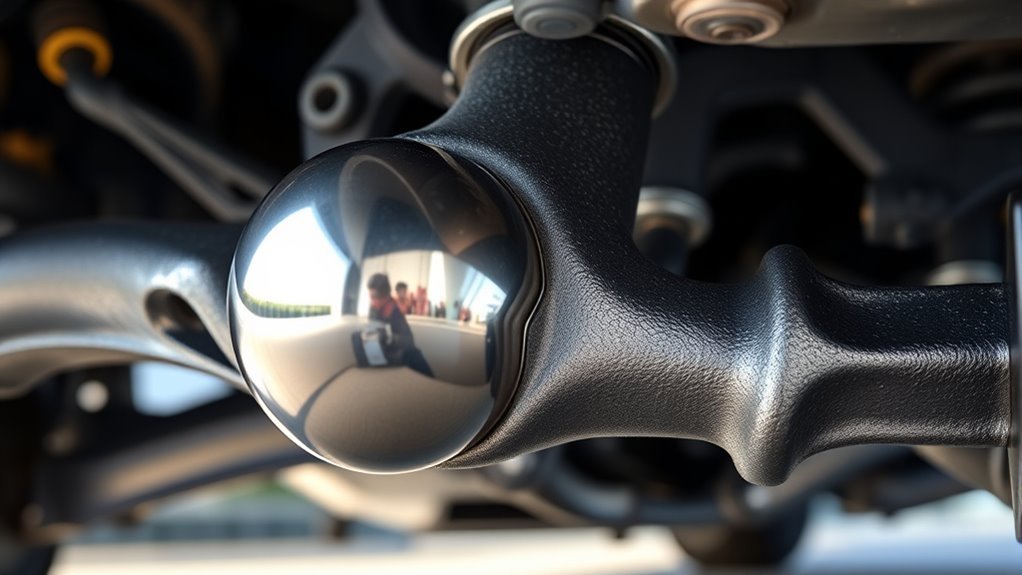
Ball joints act as crucial pivot points in your car’s suspension, letting the knuckle arm rotate smoothly when you turn the vehicle.
These ball joints support both lateral and horizontal loads, ensuring your suspension system handles stress effectively.
The knuckle arms connect the wheels to the suspension, allowing rotation around the spindle shaft and playing an essential role in steering responsiveness.
Together, ball joints and knuckle arms maintain your vehicle’s stability and precise steering control.
To keep them functioning at their best, you need to lubricate ball joints regularly.
If you notice clunking noises or unstable steering, worn ball joints could be the cause, so have them inspected and replaced promptly.
Proper care of these components keeps your suspension system reliable and your drives safe.
Stabilizer Bars and Control Rods
While ball joints and knuckle arms keep your wheels turning smoothly, stabilizer bars and control rods work to keep your vehicle steady during turns.
Stabilizer bars, also called anti-roll bars, minimize body roll by distributing weight evenly across the suspension system. They connect opposite wheels and resist lateral forces, preventing your vehicle from tipping or losing traction.
Control rods play a crucial role too, maintaining the axle’s position under lateral loads to guarantee the suspension system functions properly.
Together, stabilizer bars and control rods enhance your vehicle’s handling performance, especially during sharp or high-speed maneuvers.
Keeping these parts well-maintained is essential because worn stabilizer bars or control rods can increase body roll and reduce overall stability.
This compromise can affect your driving safety and comfort.
Upper and Lower Control Arms
You rely on upper and lower control arms to keep your wheels connected to the chassis while allowing smooth, controlled movement.
These components maintain proper alignment and stability, so your tires stay firmly on the road through every turn and bump.
Make sure to inspect them regularly—worn control arms can cause handling problems and uneven tire wear.
Function and Purpose
Think of the upper and lower control arms as your car’s arms. They connect the chassis to the wheel assembly and let the wheels move smoothly as you drive.
Each control arm plays a critical role in your suspension system by absorbing shocks from the road surface. They also maintain proper wheel alignment.
The upper control arm is shorter and mounted above the wheel. It works with the longer lower control arm to stabilize wheel movement.
Together, they ensure your tires stay in firm contact with the road. This not only provides safe handling but also prevents uneven tire wear.
Without properly functioning control arms, your ride would be unstable. Your tires would wear out quickly, compromising both comfort and safety.
Connection and Movement
Because the upper and lower control arms link the chassis to the wheel assembly, they allow your suspension to move smoothly and keep your vehicle stable as you drive.
These control arms, shaped like “a-arms” or “wishbones,” manage the critical connection and movement between the frame and wheels.
The lower control arm supports more weight and absorbs road shocks, while both arms use bushings and ball joints to enable articulation as the suspension system compresses and rebounds.
This precise movement helps maintain proper wheel alignment, which is essential for handling and vehicle safety.
Maintenance and Issues
Although control arms are built to handle significant stress, they still require regular maintenance to keep your vehicle running smoothly and safely.
You should inspect for worn or damaged control arms, as they can cause misalignment, clunking noises, and uneven tire wear.
Ignoring these signs may lead to poor handling and unsafe driving conditions.
| Issue | Symptom | Action Needed |
|---|---|---|
| Worn bushings | Clunking noises | Replace control arms or bushings |
| Bent control arm | Pulling sensation | Realign and replace if necessary |
| Damaged ball joints | Uneven tire wear | Inspect and replace promptly |
| Misalignment | Poor handling | Perform wheel alignment |
Regular maintenance guarantees your control arms function correctly, maintaining alignment and vehicle stability.
Strut Bars and Additional Components
When you add strut bars to your vehicle, you enhance the suspension system by connecting the strut towers. This boosts structural support and reduces body roll during turns.
Strut bars improve handling and performance by stabilizing the vehicle, especially at high speeds and sharp corners.
Made from lightweight materials like aluminum or steel, they provide strength without adding unnecessary weight.
Often installed as an aftermarket upgrade, strut bars let you enhance your vehicle’s suspension system without major modifications.
To keep your car performing at its best, regularly inspect and maintain the strut bars. Damaged bars can compromise handling and safety.
Incorporating these additional components helps you achieve a more responsive and stable ride, making your vehicle safer and more enjoyable to drive.
Frequently Asked Questions
What Are the Most Common Suspension Problems?
You’ll often face worn shock absorbers causing bouncing.
Broken springs lead to sagging, and damaged control arms make steering shaky.
Worn ball joints create clunks, while uneven tire wear signals suspension issues.
These problems can affect stability and ride comfort.
What Are the 5 Functions of a Suspension System?
You’ll find the five functions of a suspension system are maximizing tire-road friction, absorbing shocks, maintaining wheel alignment, managing body roll, and isolating the vehicle’s body from vibrations for a smooth and controlled ride.
Each of these functions plays a crucial role in ensuring the vehicle handles well and provides a comfortable experience for the driver and passengers.
For instance, maximizing tire-road friction helps with grip and control, especially during turns or sudden stops.
Likewise, absorbing shocks is vital for smoothing out bumps in the road, making the ride more enjoyable.
Maintaining wheel alignment is essential for even tire wear and better fuel efficiency.
Additionally, managing body roll during cornering keeps the vehicle stable and safe.
Finally, isolating the vehicle’s body from vibrations enhances comfort, allowing for a more pleasant journey overall.
What Are the Parts of a Suspension Called?
Think of your suspension as your car’s backbone.
It’s made up of springs, shock absorbers, struts, control arms, and ball joints.
They all work together, keeping your ride smooth and your wheels steady on every twist and turn.
What Are the Four Main Types of Suspension Systems?
The four main types of suspension systems you’ll find are dependent, independent, semi-independent, and hybrid.
Each type handles road bumps differently, affecting your vehicle’s stability, comfort, and overall driving experience.
Understanding these differences can really help you choose the right vehicle for your needs.
Conclusion
Now that you know the key parts of a car suspension system, you’re better equipped to keep your ride smooth and steady.
From springs to strut bars, each component plays its part in handling bumps and turns like a pro.
Remember, when it comes to suspension, every piece matters—don’t put all your eggs in one basket.
Taking care of these parts guarantees your car stays safe and comfortable on the road.
In conclusion, understanding your car’s suspension system is crucial for maintaining a smooth driving experience.
By ensuring that all components, from springs to shock absorbers, are in good condition, you can significantly enhance your vehicle’s performance and safety.
So, keep an eye on these essential parts and don’t hesitate to seek help if you notice any issues.
Your ride deserves the best care for a comfortable journey!