Essential Car Suspension Parts You Should Know About
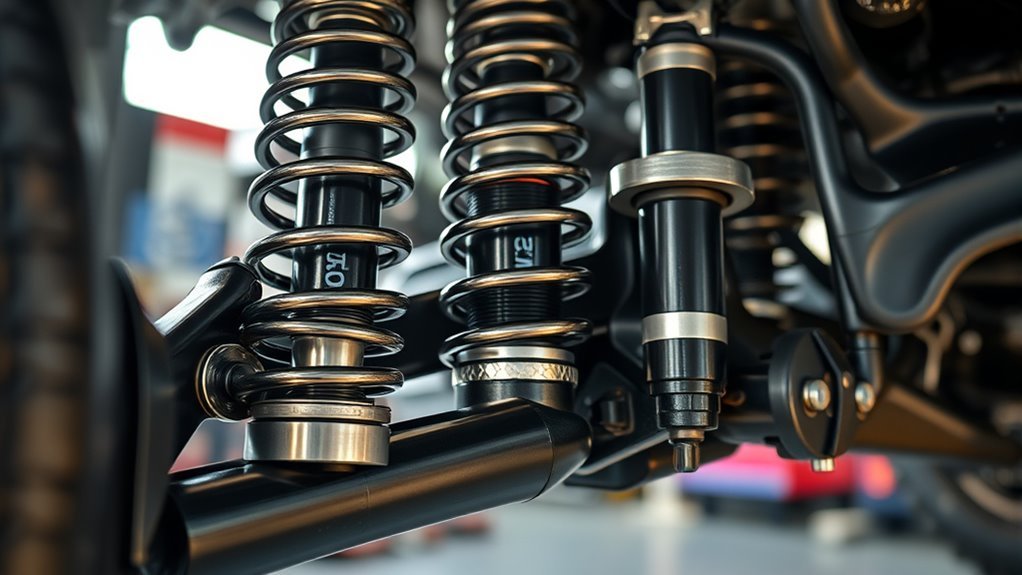
You rely on essential suspension parts like springs, shock absorbers, and struts to keep your car stable and comfortable.
These components work together to absorb bumps and control wheel movement, ensuring a smooth ride.
Anti-roll bars play a key role in minimizing body roll during turns, which enhances both safety and handling.
Control arms connect the wheels to your car’s frame, allowing for smooth up-and-down motion.
Don’t forget about strut mounts, which help with steering as well.
Understanding these crucial parts is vital for maintaining your car’s performance and safety.
So, keep exploring to uncover how each component contributes to your vehicle’s overall operation!
Key Takeaways
– Springs absorb road shocks and maintain tire contact, which improves stability and traction.
They play a crucial role in ensuring a smooth ride.
– Shock absorbers regulate spring movement to prevent excessive bouncing.
This helps enhance ride comfort, making your drive more enjoyable.
– Struts combine shock absorption with support for the vehicle’s weight.
They are vital for aiding alignment and handling, contributing to overall safety.
– Anti-roll bars work to minimize body roll during turns.
This boosts stability and tire grip, especially in sharp corners.
– Control arms are essential as they connect the wheels to the frame.
They allow for movement and ensure safe handling of your vehicle.
Springs and Their Role in Suspension
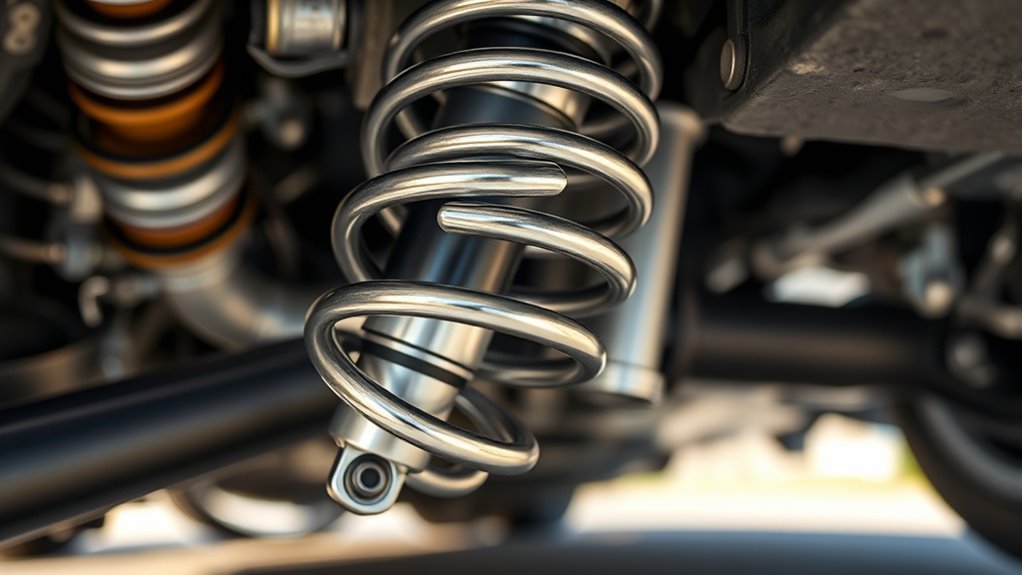
Although you might not always notice them, springs play an essential role in your vehicle’s suspension. They absorb shocks from uneven roads and keep your wheels firmly on the ground.
Among suspension components, coil springs are the most common type, made from heavy-duty steel. They compress and expand to absorb motion, directly enhancing vehicle stability and wheel traction.
Coil springs, crafted from heavy-duty steel, absorb motion to boost vehicle stability and tire traction.
This action helps maintain consistent contact between your tires and the road, which is critical for handling and safety. Springs also manage weight distribution during acceleration and braking, further supporting balanced control.
To keep your vehicle performing well, you should regularly inspect these springs for wear. Damaged springs can reduce handling effectiveness and increase tire wear.
Understanding springs’ role helps you appreciate their importance in a smooth, stable ride.
Function and Importance of Shock Absorbers
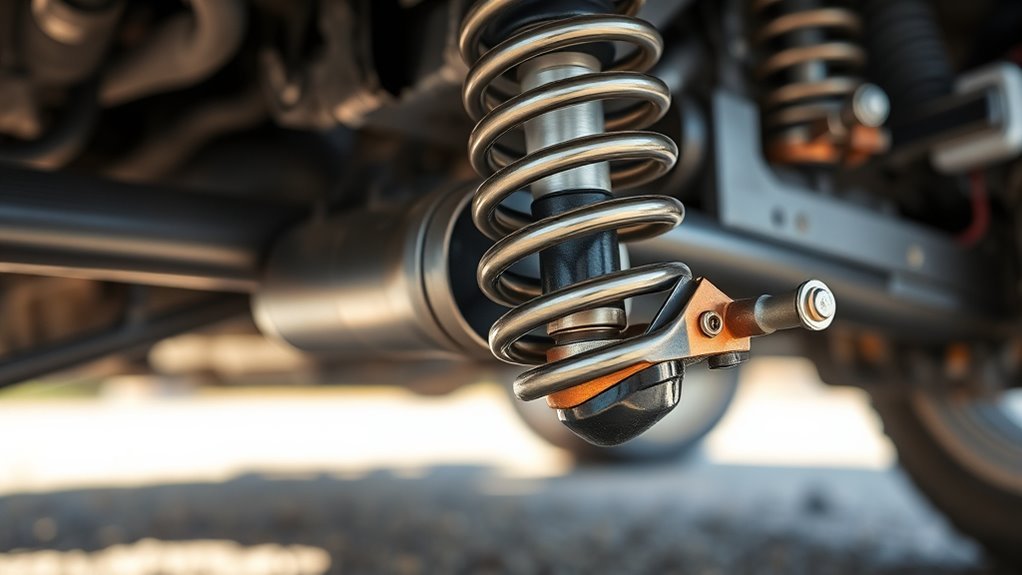
Shock absorbers play an essential role in your vehicle’s suspension by controlling the movement of the springs after you hit a bump.
They use hydraulic fluid to regulate spring compression and expansion, preventing excessive bouncing and keeping tire contact steady.
This control enhances your vehicle handling and ride comfort.
Here’s why shock absorbers matter:
- They dampen spring oscillations, ensuring a smooth ride.
- They maintain tire contact with the road for better traction.
- They improve vehicle handling by adapting to speed and road conditions.
- Routine maintenance and timely replacement prevent increased tire wear and compromised braking.
Taking care of your shock absorbers can really make a difference in how your vehicle performs!
Understanding Struts and Their Benefits
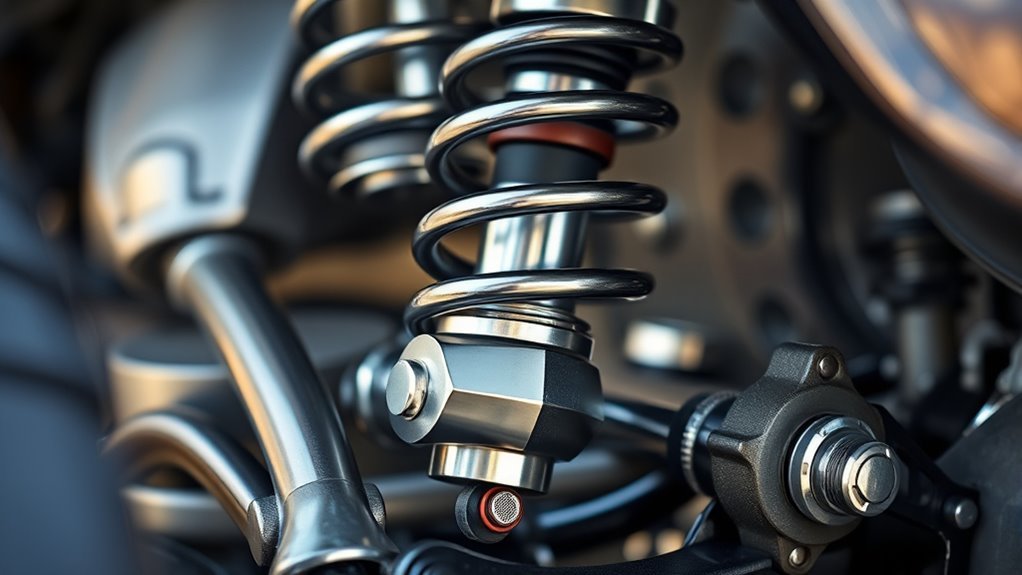
You’ll find that struts do more than just absorb shocks—they also support your vehicle’s weight and help keep your wheels aligned.
Unlike traditional shocks, struts combine multiple functions into one sturdy part. This design improves ride quality and handling.
Understanding how they work can help you appreciate why they’re essential for your car’s performance and safety.
Strut Functionality Explained
A strut plays an essential role in your vehicle’s suspension by combining the functions of a shock absorber and a structural support component.
This dual role helps control spring motion while stabilizing the vehicle frame, especially in the front suspension.
Here’s what you should know about strut functionality:
- It absorbs shocks from road impacts, smoothing out your ride.
- It provides structural support, helping maintain correct wheel alignment.
- It connects the chassis to the wheel assembly, allowing vertical movement.
- It improves steering response and overall handling dynamics.
As a key suspension part, a properly functioning strut guarantees better safety, comfort, and tire longevity.
Worn struts can cause poor handling and uneven tire wear, so keep them in good shape for peak performance.
Advantages Over Traditional Shocks
Although traditional shocks have served vehicles well for years, struts offer several advantages that can enhance your driving experience.
Struts combine shock absorbers with structural support, saving space and reducing weight in the suspension system.
They also help maintain proper wheel alignment, which improves handling and ride comfort.
Plus, their integrated dampening features control excessive spring motion, stabilizing your vehicle during turns and bumps.
Installation is easier too, often lowering labor costs.
Here’s a quick comparison:
| Feature | Traditional Shock Absorbers | Struts |
|---|---|---|
| Structural Support | No | Yes |
| Wheel Alignment | Limited | Maintains better alignment |
| Ride Comfort | Good | Enhanced with integrated dampening |
Choosing struts means better responsiveness and less body roll.
This improvement leads to enhanced overall driving stability.
Anti-Roll Bars and Vehicle Stability
When you take a sharp turn, anti-roll bars work behind the scenes to keep your vehicle steady by reducing body roll.
These bars connect the left and right sides of your suspension, enhancing vehicle stability and ensuring better control.
Connecting both sides of the suspension, these bars enhance stability and improve overall vehicle control.
By distributing weight evenly, they improve tire grip, which is essential for safe handling.
Here’s what you should know about anti-roll bars:
- They reduce body roll during cornering, keeping your ride balanced.
- Improved tire grip means sharper, safer turns.
- Their effectiveness depends on proper suspension design and installation.
- A stiffer anti-roll bar boosts responsiveness and driver confidence.
Understanding these points helps you appreciate how anti-roll bars contribute to a smoother, more controlled driving experience.
The Purpose of Anti-Roll Bar Link Rods
Anti-roll bar link rods play an essential role in connecting the anti-roll bar to your vehicle’s suspension, ensuring stability during cornering.
These suspension components transfer forces between the anti-roll bar and your vehicle’s suspension, actively reducing body roll.
By doing so, they improve handling dynamics, helping you maintain better control through turns.
Typically made from lightweight materials with ball joints, link rods allow the suspension to move flexibly over uneven surfaces without compromising vehicle stability.
When these link rods are worn or damaged, you’ll notice increased body roll and compromised handling.
This can affect your safety and comfort.
Regular inspections are vital to keep the anti-roll bar link rods functioning properly, ensuring your ride stays smooth and stable in all driving conditions.
Control Arms and Strut Mounts Explained
Besides link rods, control arms and strut mounts play key roles in how your suspension handles road conditions.
Control arms connect the wheel assembly to your vehicle’s frame, allowing up and down movement while maintaining stability through flexible bushings and ball joints.
The lower control arm, especially, supports your vehicle’s weight and links the frame to the wheel.
Strut mounts attach the strut assembly to your car body, including bearings that enable smooth steering pivot and reduce noise and vibration.
Here’s what you should know:
- Control arms are essential for stable suspension setup.
- Lower control arms bear significant vehicle weight.
- Damaged control arms affect handling and safety.
- Strut mounts impact alignment and overall ride comfort.
Regular inspections keep your suspension reliable.
Frequently Asked Questions
What Is the Best Suspension in a Car?
The best suspension in your car depends on how you drive.
For comfort, independent setups excel.
If you want performance, adjustable coilovers or adaptive systems adapt to conditions, giving you ideal handling and ride quality every time.
Which Car Is the Very Smoothest Ride?
You’ll love knowing the Mercedes-Benz S-Class offers the smoothest ride, reducing road impact by up to 40%.
Its advanced air suspension adapts instantly, so you’ll glide over bumps like you’re on a cloud every time you drive.
How Much Does It Cost to Replace Your Suspension?
Replacing your suspension can cost anywhere from $1,000 to $5,000, depending on your car and parts.
Shock absorbers and struts usually range $300 to $1,200 per axle, plus labor fees.
What Parts Are Involved in Suspension?
Think of your suspension like a team:
Springs absorb shocks, while shocks control bounce.
Control arms guide wheels, anti-roll bars prevent tipping, and ball joints pivot smoothly.
You’ve got all these parts working together for a comfortable, stable ride.
Conclusion
Think of your car’s suspension parts as the unsung heroes working behind the scenes, like the roots of a tree keeping it steady through every storm.
Knowing how springs, shock absorbers, struts, anti-roll bars, link rods, control arms, and strut mounts work helps you appreciate the ride’s smoothness and safety.
By understanding these parts, you’re better equipped to keep your vehicle balanced and comfortable, no matter where the road takes you.
In conclusion, familiarizing yourself with essential car suspension parts is crucial for ensuring a smooth and safe driving experience.
Springs, shock absorbers, and struts play vital roles in maintaining balance and comfort, while anti-roll bars and control arms contribute to overall stability.
Stay informed about these components to better care for your vehicle and enjoy a safer ride on any terrain.