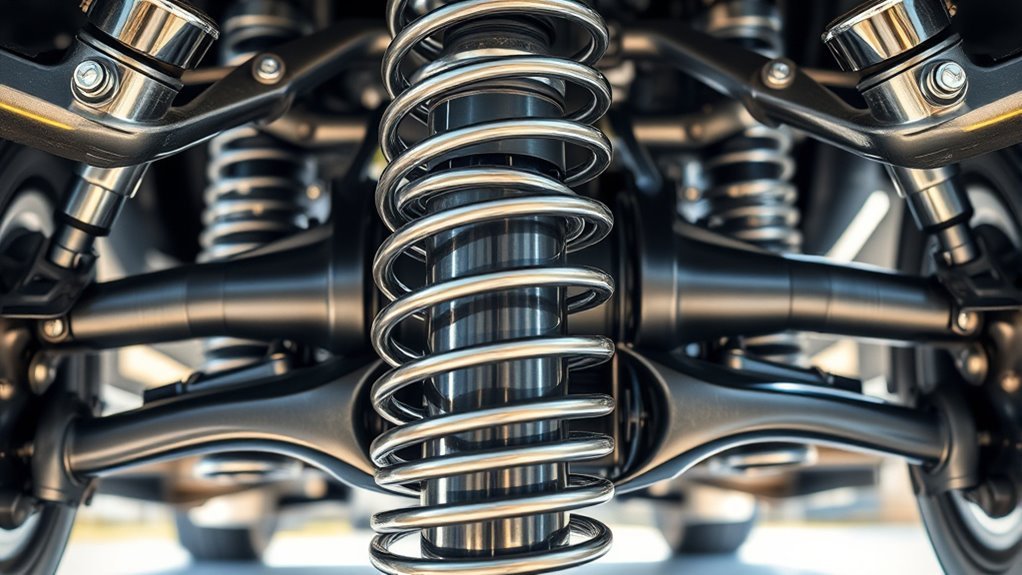
Key Principles of Car Suspension Design
You rely on your car’s suspension to absorb shocks, maintain stability, and keep tires firmly on the road for safer handling.
Key principles of car suspension design include using springs and dampers to balance comfort with control.
It’s essential to ensure flexible but strong components, like bushings, for a smooth ride.
Optimizing geometry through kinematic analysis also helps improve traction.
Proper tuning of spring rates and dampers tailors performance to specific driving conditions.
Exploring these aspects further will reveal how design choices impact your overall driving experience.
Understanding the intricacies of suspension design can make a significant difference in how your vehicle handles various terrains and situations.
So, let’s dive deeper into these principles and see how they play a role in your everyday driving.
Key Takeaways
- Suspension systems absorb road shocks to enhance ride comfort and maintain vehicle stability.
- Springs and dampers work together to control wheel movement and ensure consistent tire contact.
- Suspension geometry is designed to provide negative camber gain for improved traction and handling.
- Compliance in components balances ride comfort with vehicle control by allowing controlled flexibility.
- Tuning spring rates and damper settings adapts suspension response to various road conditions for optimal comfort.
Fundamental Functions of Car Suspension Systems
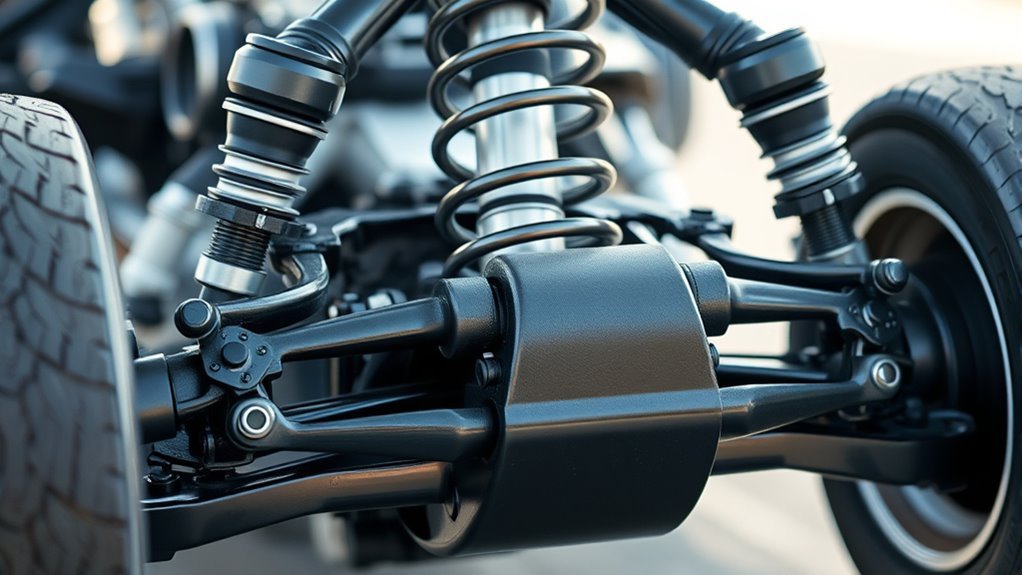
A car’s suspension system plays an essential role in smoothing out bumps and keeping your ride stable.
When you drive, the suspension system absorbs shocks from road irregularities, ensuring ride comfort and vehicle stability. Springs and dampers work together—springs absorb energy from impacts, while shock absorbers control oscillations, preventing excessive bouncing.
This balance is key to maintaining traction, as the tires need constant road contact for effective braking and handling performance.
Additionally, suspension components like anti-roll bars reduce body roll during cornering, making your drive safer and more controlled.
Essential Suspension Components and Their Roles
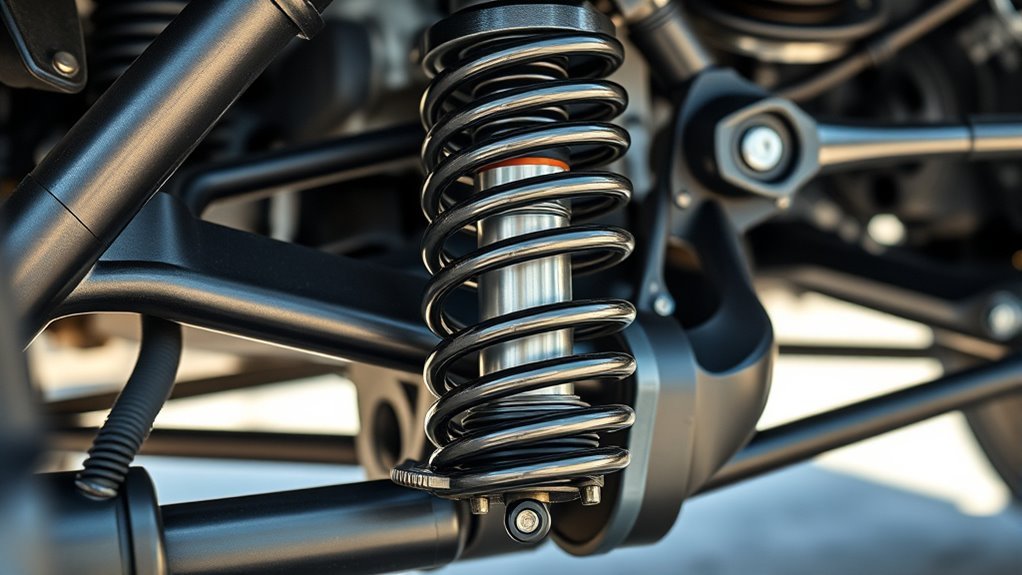
Understanding the key components of your car’s suspension system helps you appreciate how each part contributes to a smooth and controlled ride.
Suspension systems rely on springs—like coil springs—to absorb shocks from uneven roads, maintaining consistent tire contact.
Shock absorbers then dampen these movements by converting kinetic energy into heat, preventing excessive bouncing.
Shock absorbers convert kinetic energy into heat to reduce bouncing and ensure a smooth ride.
Struts combine the functions of shock absorbers and springs, providing structural support and improving ride quality.
Stabilizer bars connect the left and right sides, reducing body roll during turns and enhancing stability.
Ball joints enable suspension pivoting, handling both lateral and vertical loads while requiring regular lubrication to perform well.
Together, these components work seamlessly to balance comfort, control, and safety in your vehicle’s suspension design.
Kinematic Analysis in Suspension Design
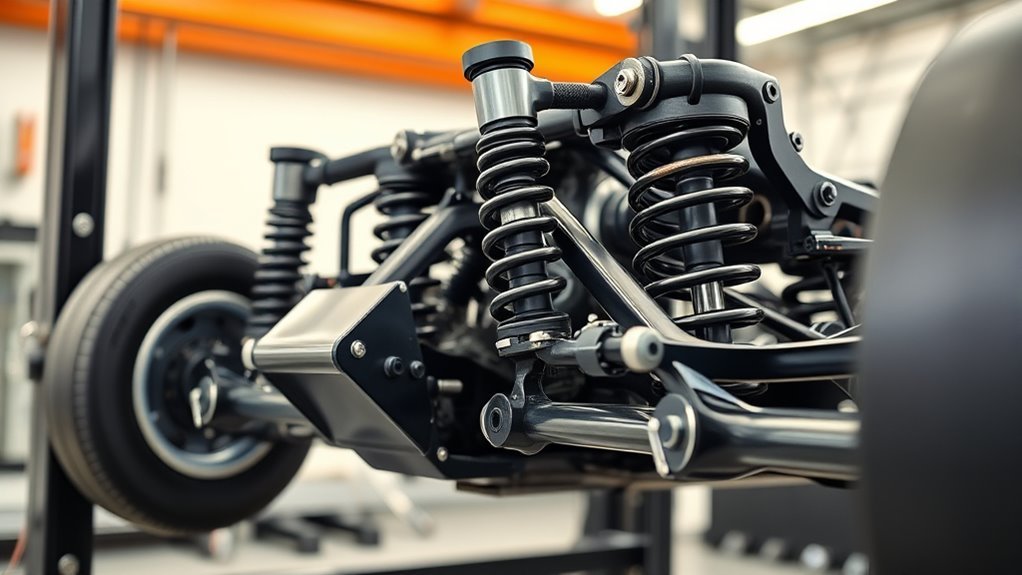
While the components of your suspension work together to manage shocks and maintain stability, how these parts move and interact directly impacts your vehicle’s handling.
Kinematic analysis helps you understand changes in suspension geometry, especially how camber angle and toe affect tire contact during driving.
Proper kinematic design guarantees negative camber gain, which improves traction and stability under lateral loads.
By pinpointing the instant center, you can predict force transmission and optimize vehicle dynamics for better cornering performance.
You’ll also see how suspension movement influences ride comfort by controlling wheel orientation over bumps.
Today, computer simulations play an essential role in kinematic analysis, letting you refine designs efficiently before building prototypes.
This approach balances handling precision and comfort, which is vital for a well-rounded suspension system.
Compliance and Flexibility in Suspension Parts
Since suspension parts must handle varying forces from the road, their compliance and flexibility play an essential role in balancing ride comfort and vehicle control.
You’ll find that suspension components like bushings and control arms use compliant materials to flex and absorb shocks, which reduces harshness and noise.
This compliance isolates occupants from road irregularities, enhancing ride comfort without compromising handling.
At the same time, controlled flexibility improves stability by allowing slight movements that adapt to road conditions.
Properly designed compliance even promotes negative camber gain during suspension compression, helping maintain tire contact for better cornering traction.
However, you need to balance flexibility carefully; too much can hurt vehicle control, while too little can make the ride harsh.
Getting this balance right is key to effective suspension design.
Tuning Suspension for Optimal Ride Comfort
Balancing compliance and flexibility in suspension parts sets the stage for tuning your suspension to achieve ideal ride comfort.
You adjust spring rates and damper settings to absorb road irregularities while keeping control. Softer spring rates improve ride comfort by smoothing bumps but may reduce handling precision, so you balance them with stiffer options.
Progressive springs help by offering a gentle response over small bumps and firm support during bigger impacts.
Progressive springs deliver smooth comfort on minor bumps and strong support during larger impacts.
Adaptive dampers take this further, adjusting in real-time to soften on smooth roads and stiffen when you drive aggressively.
Don’t overlook wheel alignment—correct camber and toe angles maximize tire contact, enhancing ride comfort and reducing uneven tire wear.
Balancing Handling Performance and Stability
You need to strike a balance between handling and stability to keep your car responsive without losing control.
Suspension geometry and dynamic load management play key roles in how your vehicle reacts during cornering and uneven surfaces.
Adjusting these elements carefully guarantees you get both sharp handling and steady stability.
Handling Versus Stability Tradeoff
Although enhancing a vehicle’s handling often means stiffening the suspension for sharper cornering response, this can reduce stability and comfort on rough roads.
To strike the right balance in your suspension setup, consider these key points:
- Adjust spring rates to improve handling performance without sacrificing ride comfort.
- Tune dampers or shock absorbers to manage energy dissipation, enhancing both stability and responsiveness.
- Employ advanced technologies like adaptive dampers that adapt firmness based on driving conditions.
- Aim for an ideal suspension design that provides feedback and control while absorbing road irregularities.
Finding the sweet spot is key!
Suspension Geometry Effects
When you fine-tune suspension geometry, you directly influence how well your tires stay in contact with the road during cornering. This has a significant impact on both handling and stability.
Adjusting angles like negative camber can improve the tire contact patch. This boosts handling performance while maintaining ride comfort.
The positioning of suspension components and instant centers also plays a crucial role. It affects how forces are managed, allowing you to achieve responsive handling tailored to varying road conditions.
| Suspension Geometry Aspect | Effect on Vehicle |
|---|---|
| Negative Camber | Enhances tire grip in turns |
| Instant Center | Influences force distribution |
| Camber, Caster, Toe | Affects steering response |
| Suspension Components | Manage load transfer |
| Tire Contact Patch | Balances handling & comfort |
Optimizing these factors guarantees a stable yet agile driving experience.
Dynamic Load Management
Effective dynamic load management relies on carefully balancing handling performance with stability.
This is done by keeping your tires firmly planted on the road through varying driving conditions.
To achieve this, you need to focus on:
- Adjusting spring rates to manage weight transfer and minimize body roll during cornering.
- Optimizing kinematic characteristics like camber gain to enhance tire contact and grip.
- Utilizing adaptive dampers that respond in real-time to changes in load, improving traction and stability.
- Ensuring your suspension setup maintains consistent tire contact, which is critical for both handling performance and overall control.
It’s all about finding that sweet spot between performance and safety!
Frequently Asked Questions
How Does a Suspension System Work in an Automobile?
Your suspension system absorbs shocks from the road by using springs and dampers, keeping your tires in contact with the surface.
It controls bouncing, guarantees stability, and improves comfort for safer, smoother driving around bumps and curves.
Pretty essential for a pleasant ride, right?
Which Car Is the Very Smoothest Ride?
You’ll find the smoothest ride in a Rolls-Royce Phantom, thanks to its “Magic Carpet Ride” suspension.
It uses dynamic dampers that expertly minimize vibrations, making every journey feel incredibly comfortable and refined.
Seriously, it’s like gliding over the road!
How Much Does It Cost to Replace Your Suspension?
Replacing your suspension typically costs between $1,000 and $5,000.
Labor runs $100 to $150 per hour, and parts like shocks, struts, and springs add to the price.
Routine checks can help you avoid bigger expenses.
What Are the Most Common Suspension Problems?
The most common suspension problems you’ll face include worn shock absorbers causing bouncing,
misaligned wheels leading to uneven tire wear.
Broken springs affect ride comfort, and damaged ball joints can cause steering issues.
Lastly, fluid leaks often signal shock failure.
Conclusion
Just as a skilled conductor harmonizes an orchestra, you must balance each suspension element to create a smooth, controlled ride.
By understanding the core functions, components, and kinematics, you guarantee your car dances gracefully over every road.
Embrace flexibility and precise tuning, and you’ll master the art of suspension design—delivering both comfort and performance with the finesse of a well-composed symphony.
Your journey to suspension excellence begins with these key principles.
—
In conclusion, mastering car suspension design is akin to conducting a symphony.
Balance, flexibility, and precise tuning are your key principles.
By grasping the essential functions and components, you can ensure a smooth ride that blends comfort and performance seamlessly.
So, embrace these elements, and watch your vehicle navigate any terrain with grace and ease.
The path to suspension excellence awaits!