What Is Off Road Car Suspension and How Does It Work?
Off-road car suspension is crucial for keeping your vehicle stable and responsive when tackling rough terrain. It absorbs shocks and maintains tire contact, allowing for a smooth ride over bumps and obstacles.
The system consists of springs, shock absorbers, and control arms. These components work together to handle irregularities in the ground while enabling the wheels to move independently, which enhances traction and control.
Thanks to off-road car suspension, you can navigate challenging landscapes with ease, minimizing the risk of damage to your vehicle.
If you’re curious to learn more about how each component contributes to your off-road performance, keep reading!
Key Takeaways
- Off-road car suspension stabilizes and absorbs shocks from rough terrain to maintain vehicle control and ride comfort.
- It combines springs, shock absorbers, and control arms to allow wheels to move independently and adapt to obstacles.
- Shock absorbers convert impact energy into heat, reducing body roll and preserving tire contact on uneven surfaces.
- Different springs like coil, leaf, and torsion provide varied shock absorption and load support tailored for off-road demands.
- Suspension tuning and ground clearance adjustments enhance traction, stability, and vehicle capability in challenging off-road conditions.
What Defines Off-Road Car Suspension
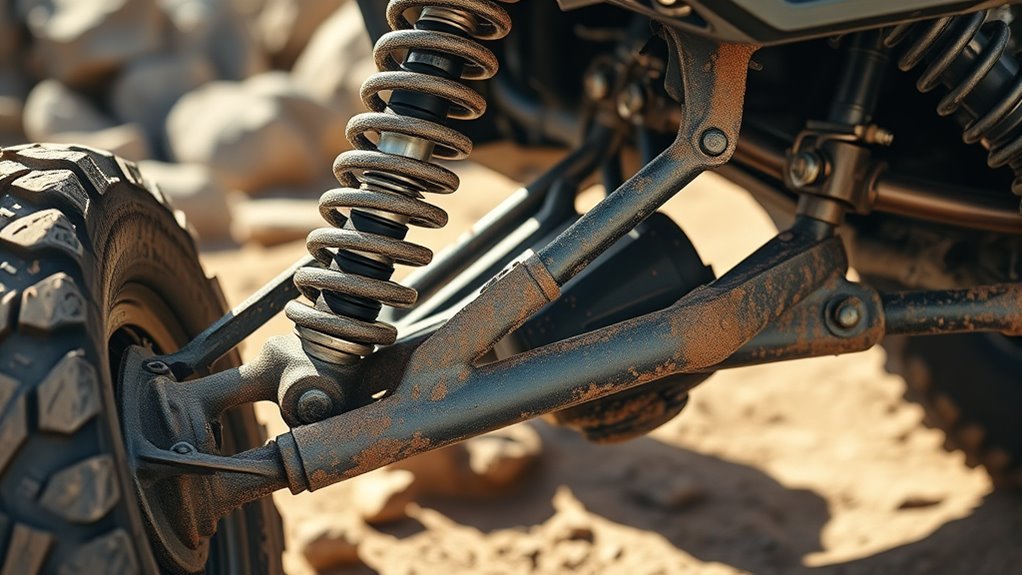
Off-road car suspension systems are designed to keep your vehicle stable and responsive on rough terrain.
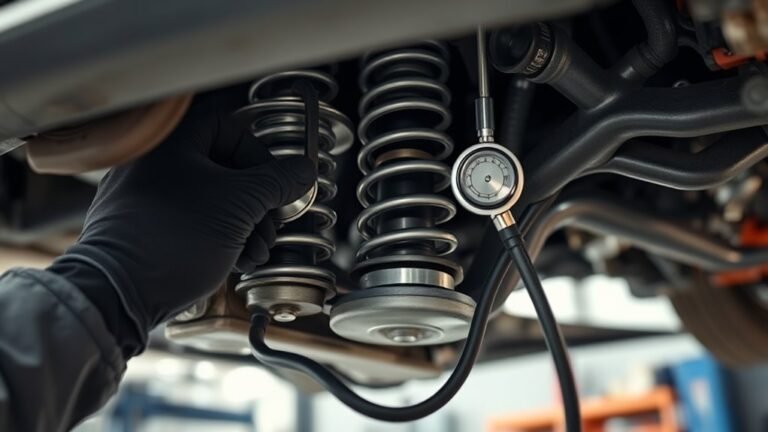
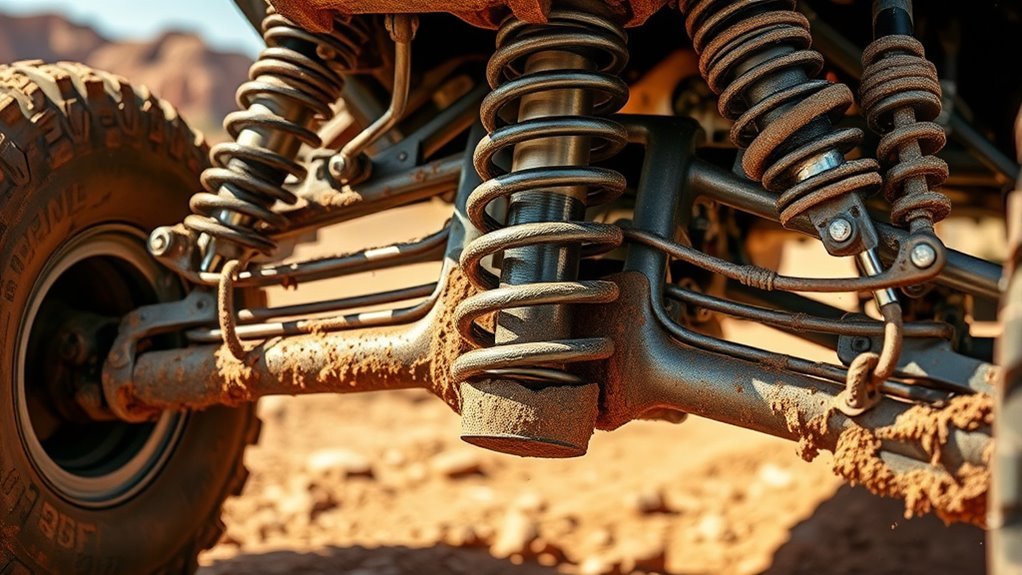
The suspension system consists of coil springs, shock absorbers, and control arms that work together to absorb impacts and maintain ride quality during off-road driving.
Coil springs provide the necessary support and flexibility, while shock absorbers control the rebound and compression.
Coil springs offer support and flexibility; shock absorbers manage rebound and compression for smooth off-road rides.
This ensures your tires stay in contact with uneven ground.
A key feature is the extensive suspension travel, which allows wheels to move up and down considerably.
This adaptability helps them navigate obstacles and rough surfaces effectively.
This combination helps you maintain traction and control, preventing loss of stability when steering through challenging landscapes.
Proper suspension tuning is essential for balancing comfort and performance in demanding off-road conditions.
Components of an Off-Road Suspension System
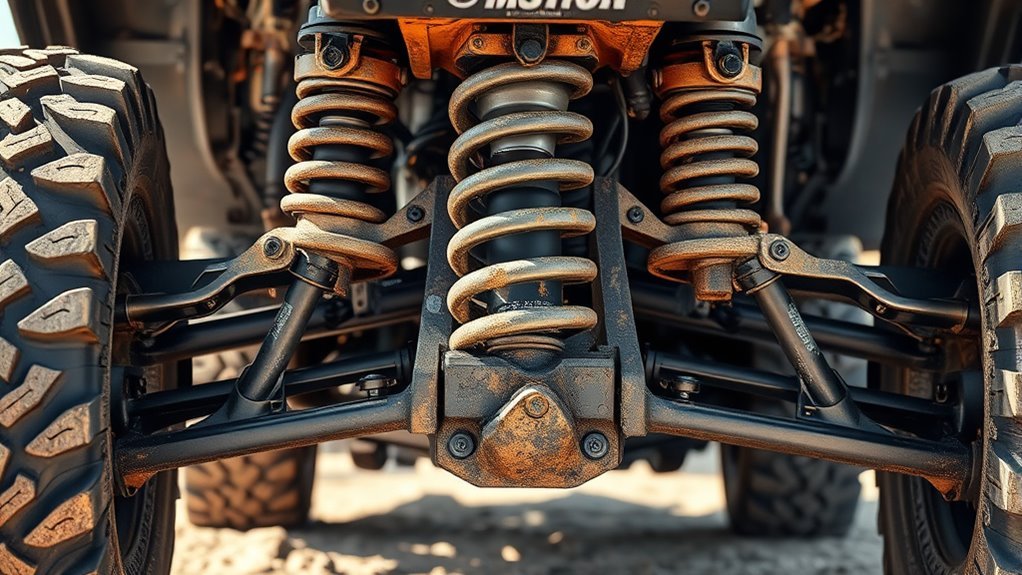
You rely on springs and dampers to absorb shocks and keep your ride smooth over rough terrain.
Control arms play an essential role by linking your vehicle’s frame to the wheels. This allows each wheel to move independently for better handling.
Together, these components guarantee your off-road suspension performs reliably where it counts.
Springs and Dampers
Although springs and dampers serve different functions, they work together to guarantee your vehicle handles rough terrain smoothly.
Springs, like leaf or coil types, absorb shocks and support your vehicle’s weight, with the spring rate determining stiffness and ride comfort.
Dampers, or shock absorbers, control suspension motion by dissipating energy through hydraulic resistance. This ensures your tires stay in contact with the ground.
Together, they enable critical wheel travel, allowing your off-road suspension to adapt to uneven surfaces while maintaining traction.
Properly tuned dampers improve stability and impact handling, especially at varying speeds.
Investing in high-quality dampers with advanced features enhances control and responsiveness, ensuring your vehicle performs efficiently across challenging terrain.
Understanding this synergy helps you optimize your off-road suspension system effectively.
Control Arms Role
Control arms connect your vehicle’s chassis to the wheel hub assembly, allowing the wheels to move in a controlled manner over rough terrain.
In offroad vehicles, these components play an essential role by absorbing shocks from bumps and dips, ensuring a comfortable ride.
When you consider a suspension upgrade, upgrading control arms is vital—they maintain proper wheel alignment and camber angles, which directly affects handling and stability.
Both upper and lower control arms work together to provide the articulation needed for uneven ground while preserving ground clearance.
Made from durable materials like tubular steel or aluminum, high-quality control arms withstand the stresses of off-road use and improve your suspension system’s longevity.
Investing in reliable control arms means better traction, control, and overall driving confidence off the beaten path.
The Role of Shock Absorbers in Off-Road Vehicles
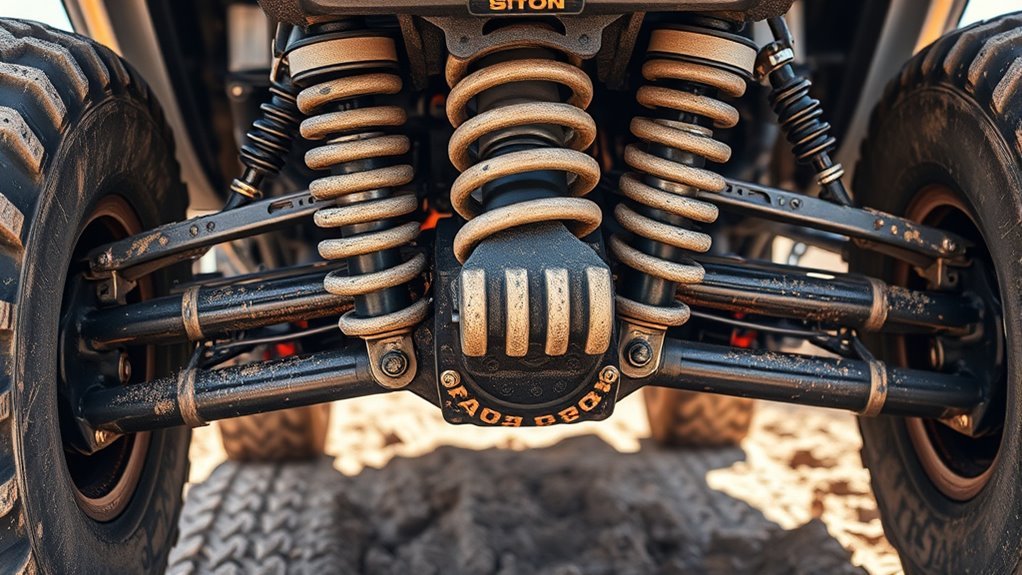
When tackling rough terrain, shock absorbers play an essential role in keeping your off-road vehicle stable and comfortable.
They control spring motion by converting bump energy into heat, reducing body roll, and maintaining tire contact with uneven surfaces.
Properly tuned shock absorbers enhance ride comfort and traction, which is crucial for harsh off-road conditions.
Your suspension system relies on these dampers to absorb impacts and prevent chassis stress.
| Feature | Function | Benefit |
|---|---|---|
| Oil-filled piston | Dampens spring motion | Smoothens ride |
| Resistance control | Converts energy to heat | Maintains stability |
| Adjustable types | Customize response | Adapt to terrain demands |
Quality shock absorbers are essential for durability and performance on rugged trails.
Types of Springs Used in Off-Road Suspensions
When setting up your off-road suspension, you’ll encounter leaf springs, coil springs, and torsion springs, each with unique strengths.
Leaf springs offer toughness for heavy loads.
Coil springs, on the other hand, provide smooth shock absorption and flexibility.
Then we have torsion springs, which let you adjust ride height in tight spaces.
Understanding these options helps you choose the right spring for your off-road needs.
Leaf Springs Characteristics
Leaf springs use stacked layers of flat steel that curve to deliver both flexibility and strength, making them perfect for off-road vehicles carrying heavy loads.
This design lets the suspension work effectively by absorbing shocks and providing stability over rough terrain.
You’ll find leaf springs commonly paired with solid axle setups, allowing impressive wheel travel and articulation.
Their spring rate can be easily adjusted by adding or removing leaves, so you can customize your ride for different loads or conditions.
Known for their durability, leaf springs withstand harsh environments and are straightforward to replace if needed.
While they offer a stiffer ride than coil springs, this stiffness helps maintain control and stability when you’re tackling challenging off-road trails.
Coil Springs Benefits
Although coil springs differ from leaf springs in construction, they offer distinct advantages that make them a popular choice for off-road suspensions.
When you install coil springs, you gain better shock absorption, which means your vehicle handles uneven terrain more smoothly.
This results in a noticeably smoother ride compared to other spring types.
Coil springs also allow for adjustable ride height, giving you the flexibility to customize your suspension setup based on load and driving conditions.
Their lighter weight improves handling and vehicle agility, especially when you’re tackling high-speed trails.
Plus, coil springs provide significant wheel travel and articulation, ensuring your tires maintain contact with the ground for better control.
Torsion Springs Function
Coil springs offer great benefits, but torsion springs bring a different set of advantages to off-road suspensions.
Torsion springs work by twisting to store and release energy, making them ideal for off-road applications where space is limited.
You’ll find them commonly used in independent suspension systems, which enhances ride quality by allowing each wheel to move independently.
This design also improves ground clearance since torsion springs are more compact than coil or leaf springs.
You can adjust ride height and stiffness by changing the amount of torsion applied, tailoring the suspension to your vehicle’s load and terrain.
Plus, their durability and resistance to fatigue make torsion springs reliable under the extreme forces and repeated stress typical of off-road driving.
How Suspension Enhances Off-Road Performance
When you tackle rough terrain, a well-tuned suspension system keeps your tires firmly planted, maximizing traction and stability.
The suspension’s springs and shock absorbers absorb impacts, ensuring all tires maintain contact with the ground even over rocky or uneven surfaces.
This continuous contact is critical for reliable off-road performance.
Articulation, or the suspension’s ability to allow wheels to move independently, lets you navigate obstacles without losing grip.
Adjusting ride height through suspension modifications increases ground clearance, helping you clear deep mud or steep inclines with ease.
Properly tuned dampers control suspension movement and reduce body roll, enhancing control during high-speed maneuvers.
Altogether, these suspension features work together to improve your vehicle’s capability and confidence off the beaten path.
Key Factors in Selecting Off-Road Suspension Components
Choosing the right off-road suspension components depends heavily on how you plan to use your vehicle and the conditions you’ll face.
You need to match spring rates to your vehicle’s weight and driving style to maintain a balanced ride.
Suspension geometry changes with lift kits, so consider compatibility and possibly aftermarket control arms to preserve handling.
Don’t overlook bump stops; they protect your suspension during extreme articulation.
| Factor | Importance | Emotional Impact |
|---|---|---|
| Spring Rates | Support load & ride quality | Confidence & control |
| Suspension Geometry | Alignment & handling | Stability & safety |
| Compatibility | Terrain & vehicle type | Freedom & reliability |
| Bump Stops | Suspension protection | Assurance & durability |
Frequently Asked Questions
What Is the Best Suspension System for Off-Road Vehicles?
The best off-road suspension for you depends on your needs: solid axles for durability and traction,
independent front suspension for comfort and control, or multi-link for adjustability and extreme performance on rough terrain.
Choose wisely!
Do Off-Road Shocks Make a Difference?
Absolutely, off-road shocks make a difference.
Like a knight’s armor protecting you, they control bumps, improve traction, and boost stability.
You’ll enjoy smoother rides and better handling on rough terrains, no matter how wild your adventure gets.
What Type of Suspension Gives the Smoothest Ride?
You’ll get the smoothest ride with independent suspension,
especially multi-link setups using coil springs.
They absorb bumps better and reduce body roll,
so your vehicle stays stable and comfortable over rough, uneven terrain.
Is Off-Road Suspension Stiffer or Softer?
Off-road suspension is usually softer to help your wheels stay in contact with uneven terrain and absorb bumps.
However, for high-speed off-roading, you’ll want stiffer setups to maintain stability and control.
Conclusion
Now that you know off-road suspension is key to conquering tough terrain, it’s clear why 4×4 vehicles with upgraded suspensions can improve ride comfort by up to 50%.
By absorbing shocks and maintaining tire contact, your suspension system keeps you stable and in control.
So, whether you’re tackling rocky trails or muddy paths, investing in the right suspension components guarantees your off-road adventures stay smooth and safe every time.
In conclusion, off-road suspension plays a crucial role in enhancing your driving experience.
With the right setup, you can significantly improve ride comfort and stability while navigating challenging environments.
Don’t underestimate the impact of a quality suspension system on your adventures; it’s an investment that pays off in both performance and safety.