Can Driving a Manual Car Improve Brain Function? Here’s What Research Says
Driving is more than reaching your destination. Every time you get behind the wheel, your brain processes a constant stream of information—traffic signals, road conditions, pedestrians, surrounding vehicles, and your own driving decisions. But does the type of transmission you drive affect how hard your brain works?
Many driving enthusiasts believe that manual transmission cars provide more than just a traditional driving experience. Because they require drivers to shift gears, operate a clutch, and pay close attention to engine speed, manual cars are often described as a workout for the brain. Some even claim that driving a stick shift helps keep the mind sharp and may reduce cognitive decline later in life.
But How Much of This Is Supported By Science?
The short answer is that manual driving does demand more cognitive effort than automatic driving, but there is no strong scientific evidence proving that it alone prevents dementia or keeps your brain significantly sharper over the long term. However, researchers do agree that learning and practicing complex skills can help maintain cognitive function.
Let’s take a closer look at what scientists say about manual driving and brain health.
Why Driving a Manual Car Requires More Mental Effort
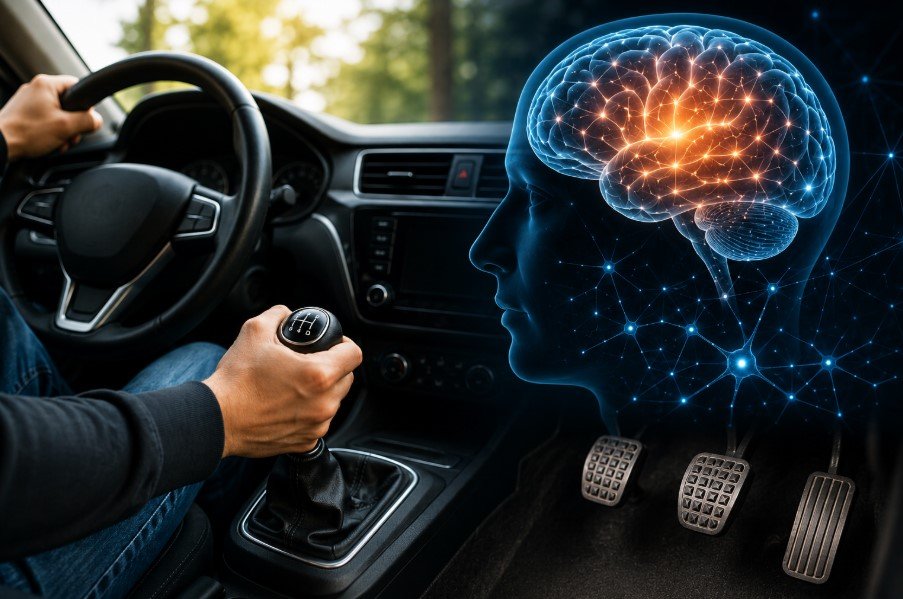
Unlike an automatic vehicle, a manual transmission requires the driver to stay actively involved throughout the journey. Every gear change requires a coordinated sequence of actions involving both hands and feet.
The driver must press the clutch, shift gears, adjust throttle input, and smoothly release the clutch while continuing to monitor traffic conditions. These actions happen repeatedly during every trip.
This continuous interaction means manual drivers rarely “switch off” mentally. Instead, they remain engaged with both the vehicle and the road.
Although experienced manual drivers eventually perform these tasks almost automatically, the brain continues coordinating multiple processes simultaneously.
How Your Brain Works While Driving
Driving activates several regions of the brain at once. The visual cortex processes road signs, lane markings, and nearby vehicles. The motor cortex coordinates steering, braking, accelerating, and gear changes. Meanwhile, the prefrontal cortex helps with decision-making, attention, and problem-solving.
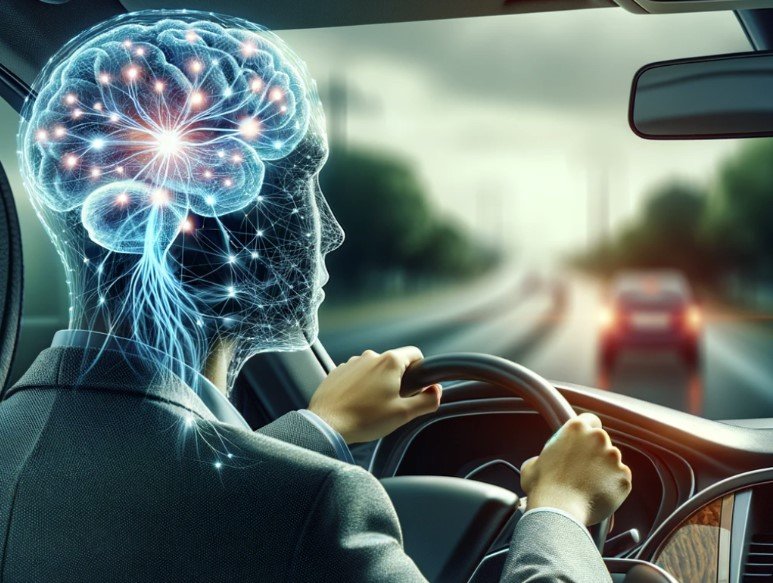
Memory also plays an important role. Drivers rely on previous experiences to recognize hazards, anticipate traffic patterns, and respond appropriately.
Reaction time is another critical component. Every second, your brain evaluates new information and decides how the vehicle should respond.
Whether driving a manual or automatic vehicle, these mental processes are constantly working together to ensure safe driving.
Why Manual Transmission Increases Cognitive Workload
Automatic vehicles simplify many driving tasks by selecting gears without driver input. Manual vehicles require the driver to make those decisions instead.
For example, climbing a steep hill requires choosing the appropriate gear, balancing the clutch, and preventing the vehicle from rolling backward. In heavy traffic, drivers constantly shift between first and second gear while coordinating clutch control.
Approaching corners requires selecting lower gears to maintain engine power. Overtaking another vehicle demands careful timing, gear selection, and acceleration.
These additional responsibilities create a higher cognitive workload than automatic driving. However, “more mental work” should not automatically be interpreted as “better brain health.”
What Scientists Say About Manual Driving and Brain Health
This is where many online claims become exaggerated. Researchers have long known that mentally stimulating activities help maintain healthy brain function. Learning new skills strengthens neural pathways through a process known as neuroplasticity, which refers to the brain’s ability to adapt and reorganize itself.
Activities requiring coordination, attention, and continuous learning may improve certain cognitive abilities because they encourage the brain to remain active.
Learning to drive a manual transmission certainly fits into this category. Beginners must develop new motor skills, coordinate multiple movements, and make quick decisions. This learning process stimulates various parts of the brain.
However, scientists have not found convincing evidence that simply driving a manual transmission prevents life altering diseases such as Alzheimer’s, dementia, or age-related cognitive decline.
Most brain health experts emphasize that cognitive health depends on a combination of lifestyle factors, including regular exercise, quality sleep, a healthy diet, lifelong learning, and social interaction.
Driving a manual car may contribute to mental engagement, but it should be viewed as one mentally stimulating activity—not a medical intervention.
Potential Cognitive Benefits of Manual Driving
Although scientific evidence remains limited, manual driving offers several logical cognitive advantages.
Improved Concentration
Manual drivers must constantly monitor engine speed, vehicle speed, road conditions, and gear selection.
This encourages sustained attention throughout the drive, especially in busy traffic or unfamiliar environments.
Better Coordination
Operating the clutch, gear lever, steering wheel, accelerator, and brakes requires precise coordination between both hands, both feet, and visual input.
Over time, these coordinated movements become smoother and more efficient.
Faster Decision-Making
Manual driving often requires quicker judgments. Making frequent driving decisions may strengthen situational awareness.
For example, changing road conditions force drivers to respond immediately, determine when to shift gears, and whether to accelerate or slow down.
Increased Driving Engagement
Report suggest increased engagement during manual transmission may also reduce boredom during long drives. Many drivers report feeling more connected to the vehicle when driving a manual transmission.
Rather than allowing the car to perform many driving tasks automatically, manual drivers remain actively involved throughout the journey.
Manual vs. Automatic: A Cognitive Comparison
Although manual driving requires more mental effort, automatic transmissions offer important advantages, particularly in heavy traffic and long commutes.
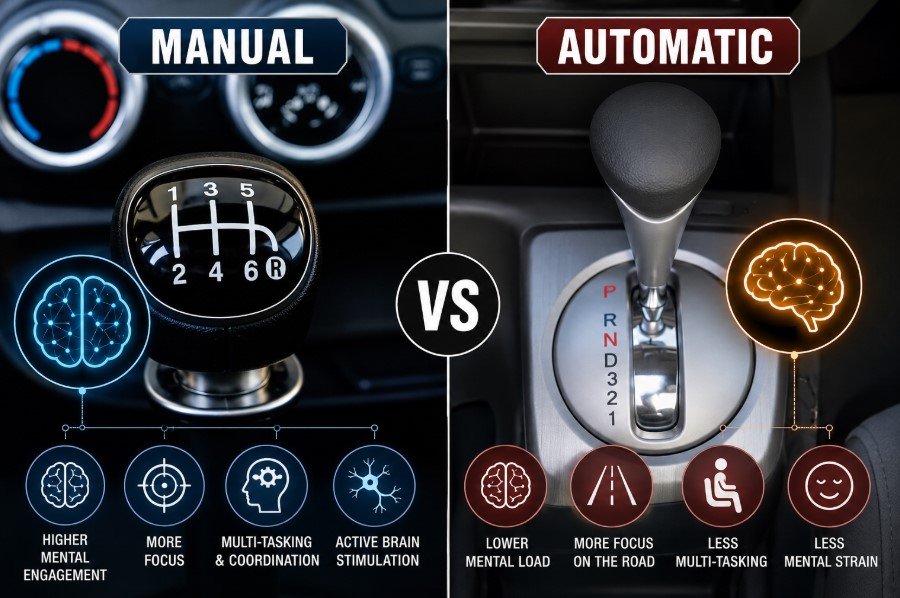
Neither transmission is inherently “better” for every driver.
| Feature | Manual Transmission | Automatic Transmission |
| Driver involvement | Very high | Moderate |
| Gear changes | Driver-controlled | Automatic |
| Clutch operation | Required | Not required |
| Mental workload | Higher | Lower |
| Learning curve | Steeper | Easier |
| Driving engagement | High | Moderate |
| Convenience in traffic | Lower | Higher |
| Physical coordination | Greater | Less demanding |
Are Automatic Cars Really Making Drivers Less Engaged?
Modern automatic transmissions are incredibly advanced. They improve fuel efficiency, reduce driver fatigue, and simplify city driving. Because drivers no longer need to think about shifting gears, they can devote more attention to surrounding traffic and potential hazards.
However, some experts suggest that reduced vehicle interaction may also increase opportunities for distraction. When driving requires less physical involvement, some drivers become more likely to glance at mobile phones, adjust infotainment systems, or lose concentration.
It’s important to remember that these distractions result from driver behavior—not from the transmission itself. Safe driving always depends on remaining focused, regardless of whether the vehicle is manual or automatic.
Other Activities That Challenge the Brain Even More
Manual driving is only one way to keep your brain active. Research consistently shows that lifelong learning provides substantial cognitive benefits.
Learning a musical instrument challenges memory, coordination, and pattern recognition. Speaking a second language strengthens attention and problem-solving skills. Reading regularly expands knowledge while improving comprehension and memory.
Games like chess encourage strategic thinking, while puzzles exercise reasoning and concentration.
Physical exercise also plays a major role in brain health by improving blood flow and supporting healthy brain function.
Compared with these activities, manual driving is best viewed as one piece of a much larger picture.
Who Benefits Most From Learning Manual Driving?
Although automatic vehicles dominate many markets today, learning to drive a manual transmission still offers practical advantages. New drivers often gain a deeper understanding of how vehicles operate because they learn about engine speed, gear ratios, and clutch control.
Driving enthusiasts appreciate the increased control and connection with the vehicle. Performance drivers and motorsport participants continue to value manual transmissions for precise gear selection.
Commercial drivers in some industries also benefit from understanding manual gearboxes, particularly when operating older vehicles or heavy equipment. Even if someone eventually switches to an automatic vehicle, learning manual driving can improve overall driving confidence.
Common Myths About Manual Cars and Brain Health
Several myths continue circulating online.
One of the most common claims is that manual cars prevent dementia. While mentally stimulating activities support brain health, there is currently no scientific evidence proving that driving a manual transmission alone prevents neurological diseases.
Another misconception is that manual drivers are automatically better drivers.
Driving skill depends on awareness, experience, judgment, and safe habits—not simply on the type of transmission.
Some people also believe automatic drivers become lazy.
In reality, automatic vehicles still require full attention, defensive driving skills, and constant awareness of changing road conditions.
The transmission may change how you operate the vehicle, but it does not eliminate the responsibility of safe driving.
Practical Ways to Keep Your Brain Active While Driving
Whether you drive a manual or automatic vehicle, you can develop better driving habits that promote mental engagement.
- Pay close attention to traffic patterns rather than relying solely on technology.
- Practice defensive driving by anticipating the actions of other road users.
- Continue improving your driving skills through advanced driving courses.
- Avoid distractions from phones and infotainment systems.
- Most importantly, treat every drive as an opportunity to stay alert and engaged.
- These habits improve both driving safety and mental focus.
Frequently Asked Questions
Does Driving A Manual Car Improve Brain Function?
Manual driving requires more concentration, coordination, and decision-making than automatic driving. While these skills engage the brain, current research does not prove that manual driving alone significantly improves long-term brain function.
Can Learning to Drive A Stick Shift Increase Intelligence?
No. Learning a manual transmission develops specific motor and coordination skills, but it does not increase intelligence. It simply teaches the brain a new and complex skill.
Is Manual Driving Harder Than Automatic?
Yes. Most people find manual driving more challenging because it requires clutch control, gear selection, and additional coordination.
Does Manual Driving Reduce The Risk of Dementia?
There is currently no scientific evidence supporting this claim. Brain health depends on many factors, including exercise, education, nutrition, sleep, and lifelong learning.
Should Everyone Learn to Drive A Manual Car?
Learning manual driving can improve your understanding of vehicle operation and increase driving confidence. However, whether it’s necessary depends on your personal needs, driving environment, and the availability of manual vehicles.
Final Thoughts
Driving a manual transmission undoubtedly requires more concentration, coordination, and active decision-making than driving an automatic. Every gear change engages multiple physical and mental processes, making manual driving a more interactive experience.
However, it’s important to separate enthusiasm from evidence. While learning and practicing manual driving may contribute to cognitive engagement, scientists have not established that driving a stick shift alone keeps your brain sharper or protects against age-related cognitive decline.