How to Measure Wheel Bolt Pattern
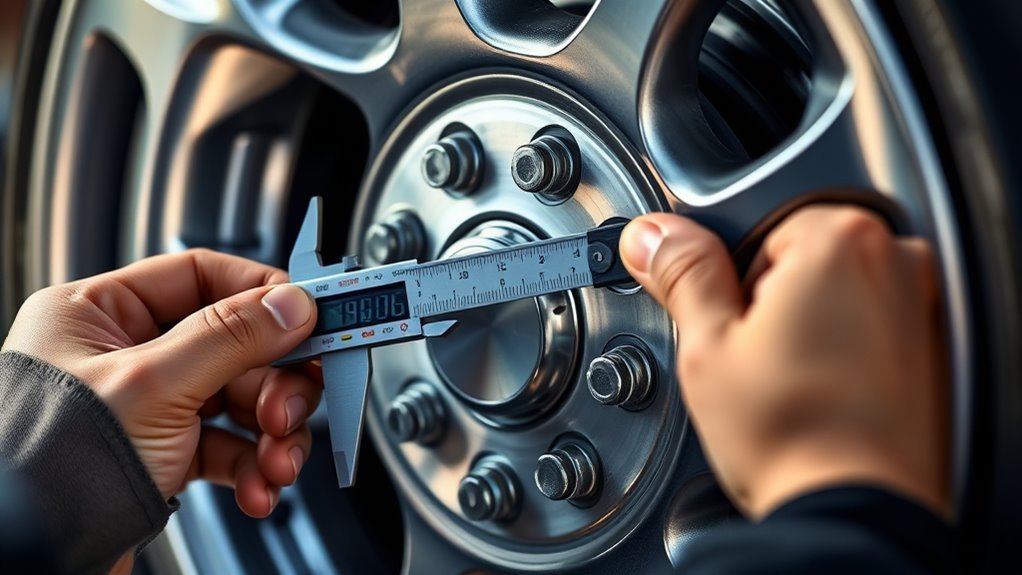
To measure your wheel bolt pattern accurately, start by counting the number of lug holes on your wheels.
Next, you’ll want to measure the diameter of the circle that these lug holes form.
For 4-lug wheels, simply measure directly across from one hole to the opposite one.
If you have 5-lug wheels, you’ll measure from the center of one lug hole to the midpoint between the two opposite holes.
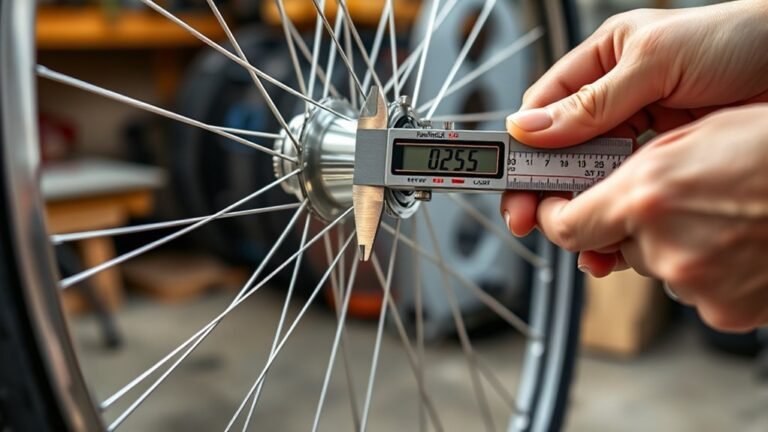
Using a tape measure or caliper will help ensure accuracy.
This process is essential for guaranteeing a secure fit and safe driving.
Now, let’s dive deeper into the tools and tips that will help you achieve precise measurements.
Key Takeaways
- Identify the number of lug holes on the wheel to determine the bolt pattern count (e.g., 4, 5, or more).
- Use a tape measure or caliper to measure the distance between lug hole centers accurately.
For 4-lug wheels, measure the diameter across two opposite lug holes.
For 5-lug wheels, measure from the center of one lug hole to the midpoint between two opposite holes.
– Record measurements carefully and verify against a bolt pattern chart before purchasing new wheels.
What Is a Wheel Bolt Pattern?
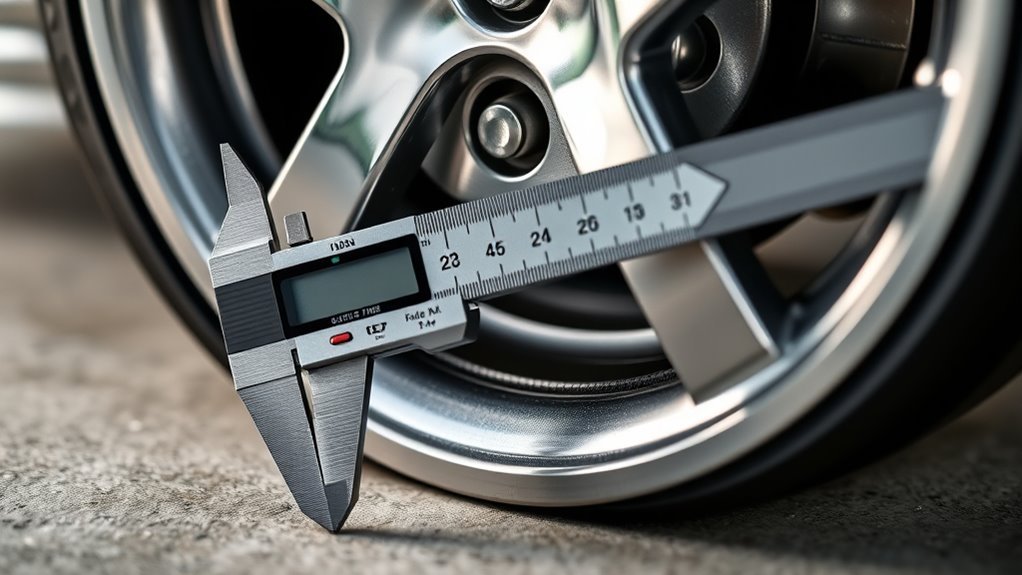
A wheel bolt pattern defines how the lug holes are arranged on your wheel, specified by the number of lugs and the diameter of the circle they form.
This pattern is typically shown as “number of holes x diameter,” like 5 x 114.3 mm.
The number of holes refers to how many lug nuts secure the wheel, while the diameter measures the distance across the circle those holes create.
You’ll often find 4-lug wheels with diameters between 100 mm and 114.3 mm.
On the other hand, 5-lug wheels commonly have patterns like 100 mm, 110 mm, or 120 mm.
Knowing this pattern helps you identify the right fit for your vehicle’s wheels.
Measuring the bolt pattern correctly is essential for safe and proper installation.
Why Accurate Measurement Matters
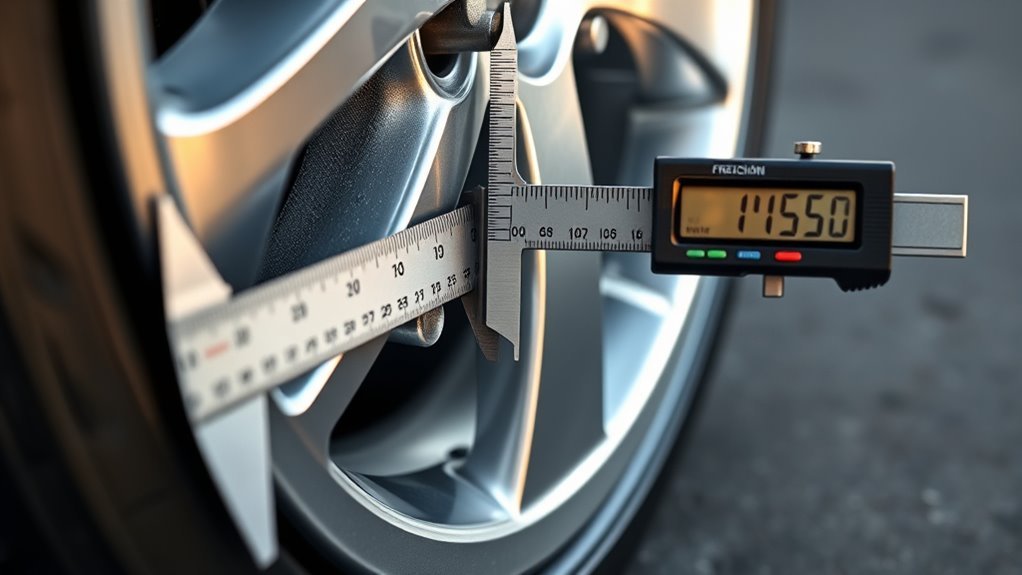
You need accurate measurements to guarantee your wheels fit securely and keep your vehicle safe on the road.
If the bolt pattern is off, you risk poor performance and potential fitment problems.
Taking the time to measure precisely helps prevent costly repairs and maintains your vehicle’s handling.
Safety and Performance
When you measure your wheel bolt pattern accurately, you prevent misalignment that can cause uneven tire wear and handling problems.
Using a bolt pattern gauge helps you determine the precise diameter and spacing between bolts, ensuring your wheels fit securely.
This accuracy is essential for safety, as improperly fitted wheels risk detachment at high speeds, leading to dangerous accidents.
Correct bolt pattern measurement enhances vehicle performance by improving stability and steering response.
This gives you better control on the road and minimizes vibrations, protecting suspension components and maintaining ride comfort.
Regularly checking your wheel bolt pattern with the right tools guarantees your vehicle stays safe and performs effectively, especially when upgrading or changing wheels.
Don’t overlook this critical step!
Preventing Fitment Issues
Since improper bolt pattern measurements can cause serious fitment problems, you’ll want to confirm your wheels align perfectly every time.
Accurate lug pattern measurement prevents misalignment, unsafe handling, and costly repairs.
Use a bolt pattern gauge for precision, especially with complex 5-lug patterns.
Always cross-check with manufacturer specs before upgrading wheels.
| Issue | Cause | Result |
|---|---|---|
| Wheel misalignment | Incorrect lug pattern | Uneven tire wear |
| Wheel detachment | Poor bolt pattern fit | Safety hazard while driving |
| Costly repairs | Improper bolt patterns | Expensive part replacements |
Measuring properly confirms your wheels fit securely, maintaining safety and performance on the road.
Tools Needed for Measuring Bolt Patterns
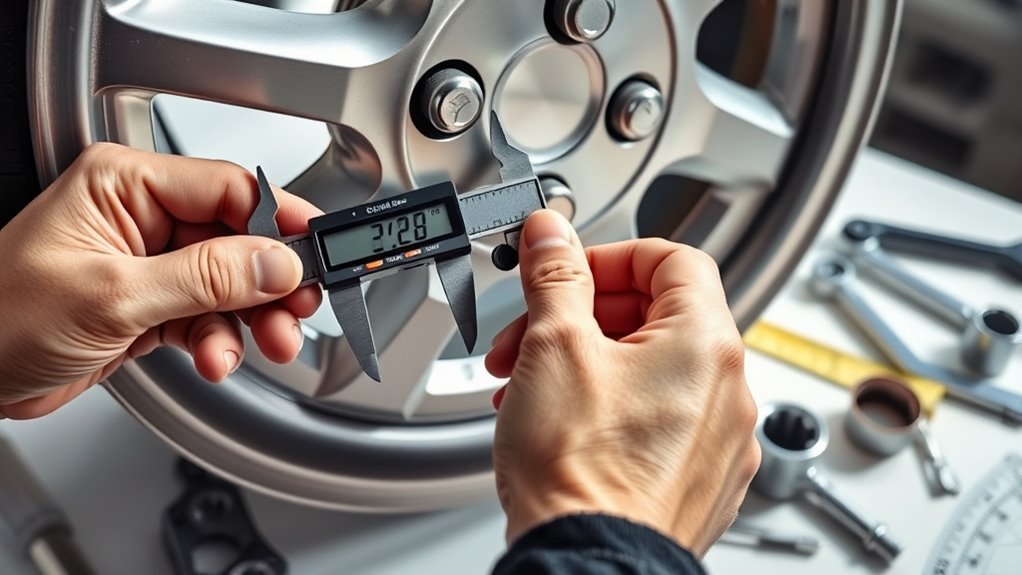
Several essential tools make measuring wheel bolt patterns straightforward and accurate.
You’ll need a lug nut wrench to safely remove the lug nuts, giving you clear access to the wheel studs.
A measuring tape or caliper is vital for measuring the distance between lug holes precisely, whether across or from one lug to the center of another.
Using a marker or tape helps you mark the measurement points, ensuring consistency.
Don’t forget gloves to protect your hands while handling the wheel and tools.
Finally, having a reference chart of common bolt patterns allows you to compare your measurements against standard specifications, confirming accuracy.
With these tools, you’ll confidently measure bolt patterns without guesswork or error.
Measuring Bolt Patterns on 4-Lug Wheels
Start by locating the exact centers of the lug holes on your 4-lug wheel.
Then, measure the diameter across the holes directly opposite each other to get the bolt pattern size.
Finally, double-check your measurement against a bolt pattern chart to guarantee accuracy.
Identifying Lug Hole Centers
When measuring the bolt pattern on 4-lug wheels, you’ll need to locate the centers of two opposite lug holes accurately.
Start by visually identifying these opposite lugs on the wheel.
Using a measuring tape or caliper, measure the distance from the center of one lug hole straight across to the center of the opposite lug hole.
This measurement reflects the diameter of the circle formed by the lug holes, which is essential for determining the correct bolt pattern.
Typical 4-lug patterns range from 100 mm to 114.3 mm, depending on the vehicle.
After measuring, always compare your results with a reference guide to verify the pattern matches your vehicle’s specifications before buying new wheels.
Accurate lug center identification guarantees a proper fit and safe installation.
Measuring Diameter Across Lugs
After pinpointing the centers of two opposite lug holes, you can measure the bolt pattern diameter on your 4-lug wheel.
To do this, use a measuring tape or caliper to measure the distance directly from the center of one lug hole to the center of the lug hole across from it.
This distance represents the diameter of the circle formed by the lug holes.
For 4-lug wheels, this diameter typically ranges between 100 mm and 114.3 mm, depending on your vehicle model.
Make certain your measurement is accurate since even slight errors can cause improper fitment and safety issues.
Once you have this diameter of the circle, you’ll be ready to confirm your wheel’s bolt pattern and guarantee it matches your vehicle’s specifications.
Confirming Bolt Pattern Size
To confirm the bolt pattern size on your 4-lug wheels, measure the distance straight across from the center of one lug hole to the center of its opposite.
This measurement represents the bolt pattern, often noted as “4 x [distance].”
Make sure to measure exactly across the diameter formed by the lug holes for accuracy.
Using a bolt pattern gauge can help you verify this measurement precisely.
The bolt pattern size is essential for matching your wheels and lug nuts correctly, ensuring proper fit and safety.
| Bolt Pattern | Diameter Range |
|---|---|
| Common Size | 100 mm to 114.3 mm |
| Example | 4 x 100 mm |
Check your measurement against this table to confirm compatibility with your lug nuts.
Measuring Bolt Patterns on 5-Lug Wheels
Measuring the bolt pattern on 5-lug wheels requires locating any bolt hole and then measuring from its center to the midpoint between the two adjacent holes.
This approach accounts for the uneven spacing unique to 5-lug configurations, ensuring you get an accurate bolt pattern measurement.
Common 5-lug patterns include 5×100 mm, 5×110 mm, and 5×120 mm, where the first number represents the number of lugs and the second is the diameter in millimeters.
Typical 5-lug bolt patterns include 5×100, 5×110, and 5×120 millimeters.
To improve accuracy, you can use a bolt pattern gauge designed for complex layouts like 5-lug wheels.
After measuring, always check your results against manufacturer specs or compatibility guides to confirm that your identified bolt pattern matches your vehicle’s requirements.
This prevents mistakes when selecting replacement wheels.
Verifying and Using Your Bolt Pattern Measurement
One key step you shouldn’t skip is verifying your bolt pattern measurement against a reliable chart or your vehicle’s specifications.
Check both the number of lugs and the bolt hole diameter carefully to guarantee they match your lug wheel setup.
Using a bolt pattern gauge can help, especially if your wheel has an odd number of lugs. It reduces errors that could cause fitment issues.
Before buying new wheels, confirm the bolt pattern matches your current one to prevent misalignment or detachment risks.
Always consult your vehicle’s owner manual or manufacturer specs to cross-check.
Finally, document your bolt pattern measurement for future reference or when discussing options with professionals.
This ensures you get the perfect lug wheel fit every time.
Frequently Asked Questions
How Do You Measure a 5 Lug Bolt Pattern?
You measure a 5-lug bolt pattern by measuring from the center of one lug hole to the midpoint between the two adjacent lug holes.
Use calipers for accuracy and express it as “5 x diameter” in millimeters or inches.
Is 5×4.5 and 5×114.3 the Same Bolt Pattern?
Yes, 5×4.5 inches and 5×114.3 mm are the same bolt pattern.
You just need to remember that 4.5 inches converts to 114.3 mm,
so they match perfectly for wheel fitment on many vehicles.
How Do I Know My Bolt Pattern Size?
Think of your wheel as a clock face; count lug holes and measure between them.
For 5-lug wheels, measure from one lug to the midpoint of the opposite pair.
That’s how you find your bolt pattern size!
What Does 5 on 4.5 Bolt Pattern Mean?
A 5 on 4.5 bolt pattern means your wheel has five lug holes arranged in a circle with a 4.5-inch diameter.
This configuration ensures your wheels fit properly and match your vehicle’s hub assembly for safe driving.
Conclusion
Now that you’ve got the rhythm of measuring wheel bolt patterns down, you’re ready to steer with confidence.
Think of your bolt pattern as the heartbeat of your wheels—when measured right, everything flows smoothly like a well-oiled machine.
So, grab your tools, trust your hands, and let precision guide you.
With every bolt in place, you’re not just fitting wheels; you’re setting the stage for a ride that’s steady and true.
In conclusion, measuring the wheel bolt pattern is essential for ensuring that your wheels fit perfectly.
By following the right steps and using the right tools, you can achieve a stable and safe ride.
So, get out there, measure with care, and enjoy every drive knowing your wheels are securely in place!