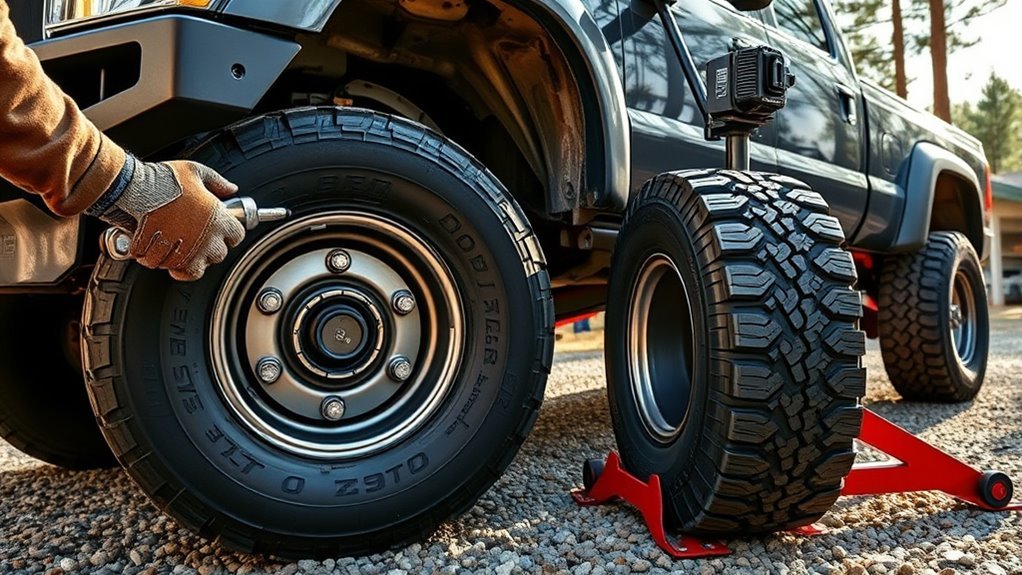
5 Steps to Rotate Tires on Your 4-Wheel Drive Truck
To rotate tires on your 4-wheel drive truck, it’s essential to know the proper steps to ensure even wear and longevity.
Start by parking your truck on a level surface.
Engage the parking brake and loosen the lug nuts slightly.
Next, lift the truck using a jack and support it securely with jack stands.
Once the truck is elevated, choose the right rotation pattern—typically the X-pattern is best for even wear.
Then, swap the tires accordingly, ensuring they are placed correctly.
When it’s time to tighten the lug nuts, use a torque wrench and do so in a crisscross pattern to the recommended torque specifications.
By following these basics, you’ll help keep your tires balanced and lasting longer.
There’s more to uncover about each step, so let’s dig deeper into the process!
Key Takeaways
– Park your 4-wheel drive truck on a level surface.
Engage the parking brake and slightly loosen all lug nuts before lifting the vehicle.
– Use a car jack and jack stands at designated jacking points to safely lift and support the truck.
This is important before you remove the tires.
– Select the appropriate tire rotation pattern for 4-wheel drive trucks.
The X-pattern is commonly recommended to ensure even tread wear.
– Swap tires according to the chosen pattern.
Move front tires to opposite rear positions and vice versa.
– Tighten lug nuts in a crisscross pattern to the specified torque.
Don’t forget to check tire pressure and recheck lug nuts after driving 50 to 100 miles.
Prepare Your Truck and Workspace
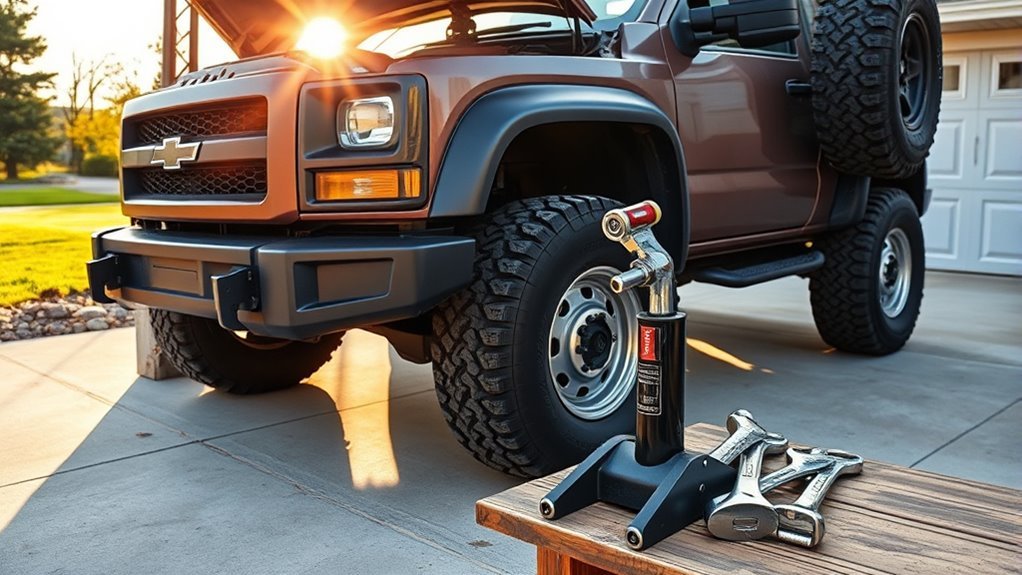
To start, park your truck on a level surface and engage the parking brake to keep it stable and secure.
This guarantees safety and prevents any movement during the tire rotation.
Next, prepare your work area by clearing obstacles and ensuring good lighting.
Clear your work area of obstacles and ensure ample lighting for a safe, efficient tire rotation process.
Gather all necessary tools, including a car jack, jack stands, a lug nut wrench, and possibly a torque wrench for reinstalling lug nuts properly.
Locate the jacking points specified in your truck’s owner manual to avoid damage when lifting.
Before raising the truck, slightly loosen the lug nuts on each wheel to make removal easier once elevated.
Taking these careful steps to prepare your truck and workspace sets a safe, efficient foundation for the tire rotation process.
Loosen Lug Nuts and Lift the Vehicle
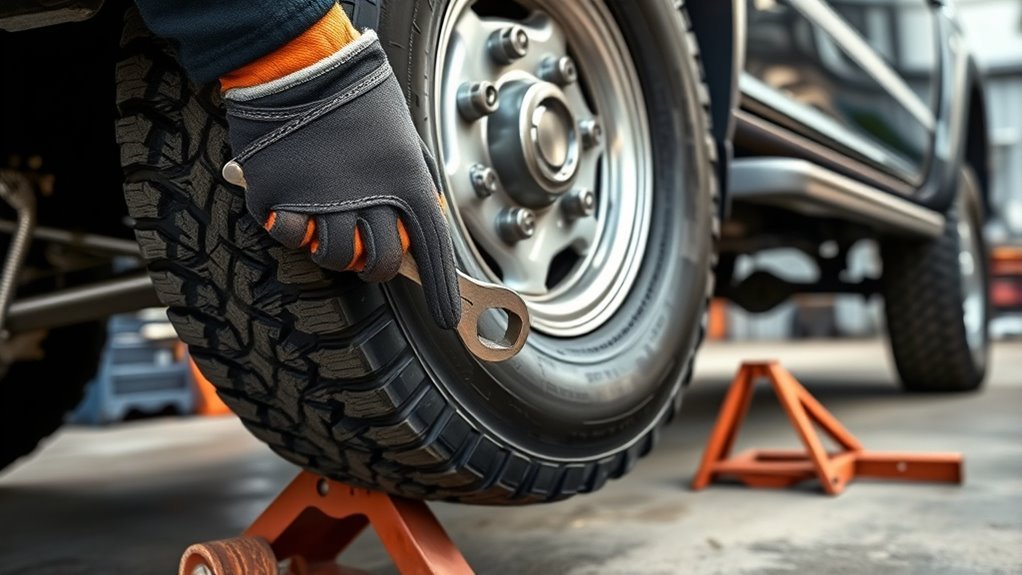
Start by slightly loosening all the lug nuts on your tires while the truck is still on the ground. This prevents the wheels from spinning when you lift the vehicle.
Before lifting, engage the parking brake to keep your truck from moving.
Next, position your car jack at the designated jacking points and carefully lift the vehicle until the tires are off the ground.
Once elevated, place jack stands under the truck to provide stable, additional support. This step is essential for safety while you work.
After confirming the vehicle is stable, fully remove the loosened lug nuts and take off the tires to rotate them according to the next steps.
Following these precautions guarantees a safe and efficient tire rotation process on your 4-wheel drive truck.
Select the Appropriate Rotation Pattern
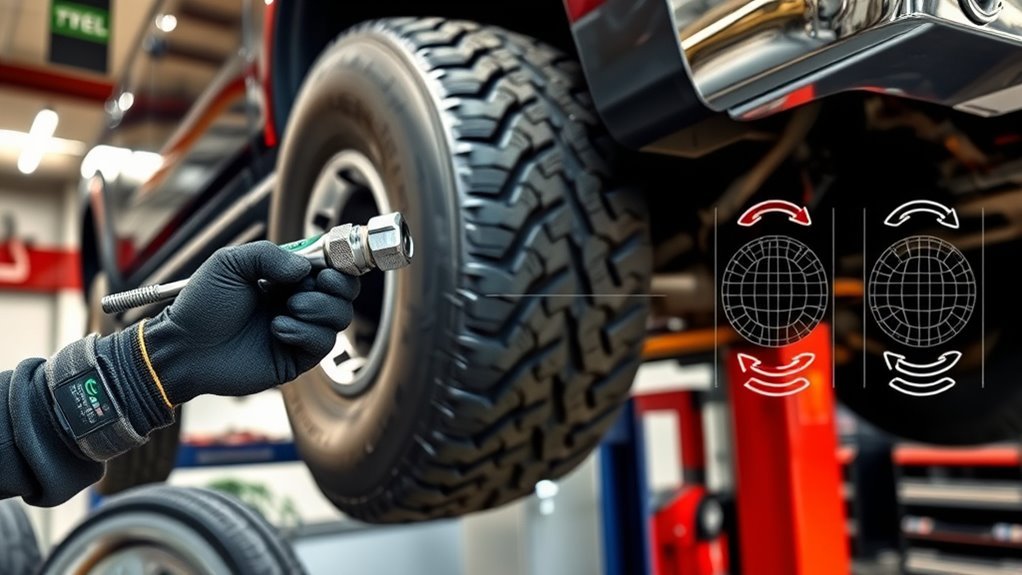
Although there are several rotation patterns to choose from, selecting the right one for your 4-wheel drive truck is essential to guarantee even wear and extend tire life.
The most common tire rotation patterns vary based on drive type and tire configuration. Always check your vehicle’s owner’s manual for specific patterns or consult a professional or tire shop to ascertain peak performance.
Rotation helps balance wear across all tires, especially with staggered sizes.
| Pattern Name | Best For |
|---|---|
| X-Pattern | 4-wheel drive, promotes even wear |
| Rearward Cross | Rear-wheel drive trucks |
| Front-to-Rear | Same size tires only |
| Specific Patterns | Staggered sizes, consult manual |
Swap Tires According to the Pattern
You’ll swap your tires diagonally using the X-Pattern to keep wear balanced on your 4-wheel drive truck.
Start by inspecting each tire for uneven wear to prevent moving a damaged tire to a different axle.
Begin by checking each tire for uneven wear to avoid relocating damaged tires to another axle.
In this pattern, the front left tire moves to the rear right, the front right shifts to the rear left, the rear left goes to the front right, and the rear right switches to the front left.
This swap guarantees even tread wear across all tires. Always consult your owner’s manual for any model-specific rotation patterns or torque specs.
After swapping, you’ll tighten the lug nuts in a star pattern to assure even pressure and secure fitment.
Following this method helps maintain peak performance and prolongs tire life.
Tighten Lug Nuts and Perform Final Checks
Once you’ve swapped the tires following the X-pattern, focus on tightening the lug nuts using a crisscross pattern.
This guarantees even pressure across the wheel, preventing warping or uneven wear.
Use a torque wrench to tighten lug nuts to the manufacturer’s specified torque, usually between 80-100 foot-pounds for most 4-wheel drive trucks.
After securing the wheels, perform final checks by inspecting each tire for signs of damage or uneven wear.
Don’t forget to adjust the tire pressure to the recommended levels, as pressure can fluctuate with tire position changes.
Finally, remember to recheck the lug nuts’ tightness after driving 50 to 100 miles to keep them secure and avoid any issues caused by tire settling.
Frequently Asked Questions
Do I Need to Do a Tire Rotation With 4wheel Drive?
Yes, you do need to rotate tires on your 4-wheel drive truck regularly.
It guarantees even wear, improves handling, and extends tire life.
Don’t skip it; rotating every 3,000 to 5,000 miles keeps your truck performing well.
What Is the Best Tire Rotation Pattern for a 4-Wheel Drive Car?
Back in the days of horse-drawn carriages, you’d still want the X-pattern for your 4-wheel drive car.
It swaps tires diagonally, ensuring even wear and balanced handling.
How to Do a Tire Rotation on an AWD Vehicle?
You’ll use the X-pattern or Rearward Cross rotation.
Jack up your AWD vehicle safely, remove tires, and swap positions accordingly.
Then, torque lug nuts in a star pattern.
Finally, recheck torque after driving 50-100 miles.
How Do I Rotate My 4-Wheel Drive Tires?
Like a chess player strategizing moves, you’ll swap your 4WD tires diagonally using the X-pattern.
Loosen lug nuts first, then jack up the truck.
After that, rotate the tires and tighten the nuts securely.
This process helps ensure even tire wear and safer drives.
Conclusion
Now that you’ve mastered these steps, your truck’s tires will enjoy a well-deserved change of scenery.
This helps them wear more evenly and last longer.
Taking this small but thoughtful action not only keeps your ride smoother but also honors the hard work your truck does every day.
With a little care and attention, you’re giving your tires the best chance to keep rolling strong, mile after mile.
By regularly rotating your tires, you’re ensuring optimal performance and safety for your 4-wheel drive truck.
So, keep up with this maintenance routine to prolong tire life and enhance your overall driving experience.
Your truck will thank you for it!