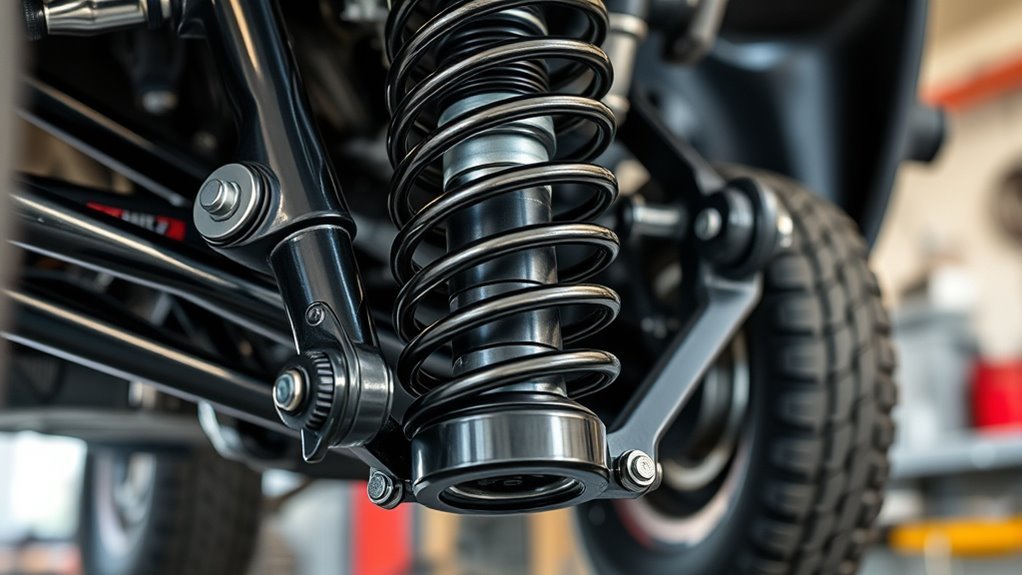
Key Parts of a Car Suspension System
You rely on your car’s suspension system to keep your ride smooth and stable. This system is crucial for comfort and safety while driving.
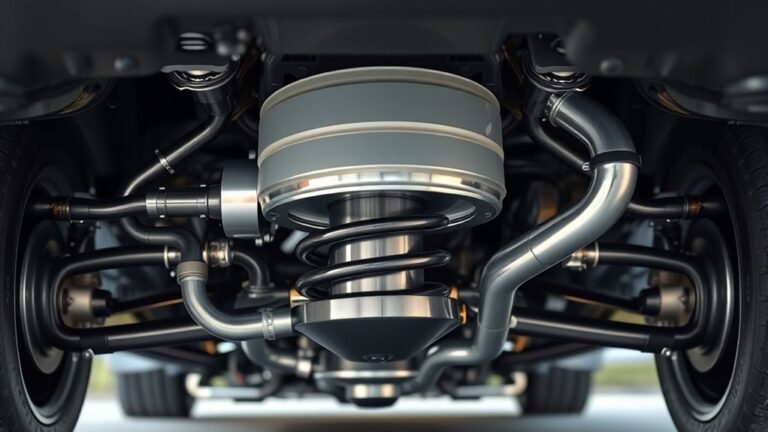
Key parts include springs that absorb shocks from the road, ensuring that bumps don’t jolt you around.
Shock absorbers come into play by controlling bouncing and dampening movements, helping maintain a steady drive.
Ball joints and knuckle arms allow your wheels to move and steer precisely, which is essential for maneuverability.
Stabilizer bars work to reduce body roll during turns, keeping you balanced and secure.
Moreover, upper and lower control arms are vital for maintaining proper wheel alignment, which enhances safety on the road.
There’s so much more to how these components work together, contributing to a comfortable and enjoyable driving experience.
Key Takeaways
– Springs absorb shocks from road irregularities, maintaining vehicle balance and ride smoothness.
They play a crucial role in ensuring a comfortable driving experience.
– Shock absorbers dampen spring motion to reduce bouncing and improve tire contact with the road.
This helps in providing better control and stability while driving.
– Ball joints connect control arms to knuckle arms, allowing smooth wheel movement and steering.
They’re essential for facilitating the car’s maneuverability.
– Stabilizer bars minimize body roll during turns, enhancing handling and vehicle stability.
This feature is key for keeping the vehicle grounded during cornering.
– Upper and lower control arms link the chassis to the wheel hub, ensuring proper wheel alignment and shock absorption.
They contribute significantly to the overall performance and safety of the vehicle.
Springs
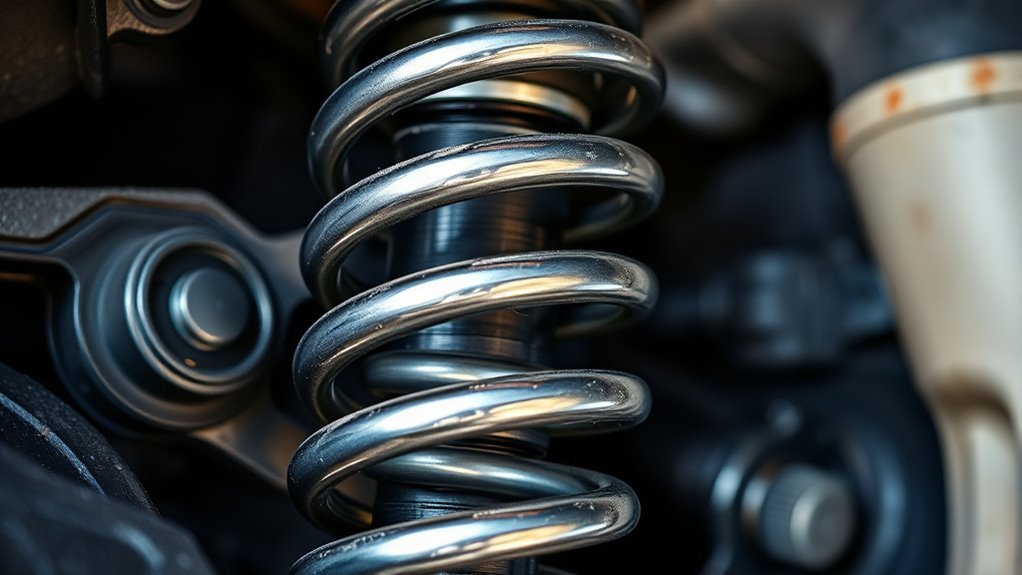
Although you might not notice them while driving, springs play an essential role in your car’s suspension system.
They absorb shocks from uneven roads and keep your ride smooth.
Springs like coil springs compress and expand to absorb the impact, helping to keep your car balanced.
Coil springs compress and expand to absorb shocks, ensuring your car remains balanced and smooth on the road.
Leaf springs, made of layered metal strips, offer strength and flexibility, especially in heavy-load vehicles.
Torsion bars twist to provide additional support in certain designs.
These springs work alongside shock absorbers to maintain your vehicle’s suspension system’s effectiveness.
This ensures your wheels maintain traction and your ride stays stable.
If springs wear out or get damaged, your car will bounce more, lose stability, and safety could be compromised.
That’s why keeping springs in good shape is crucial for safe, comfortable driving.
Shock Absorbers
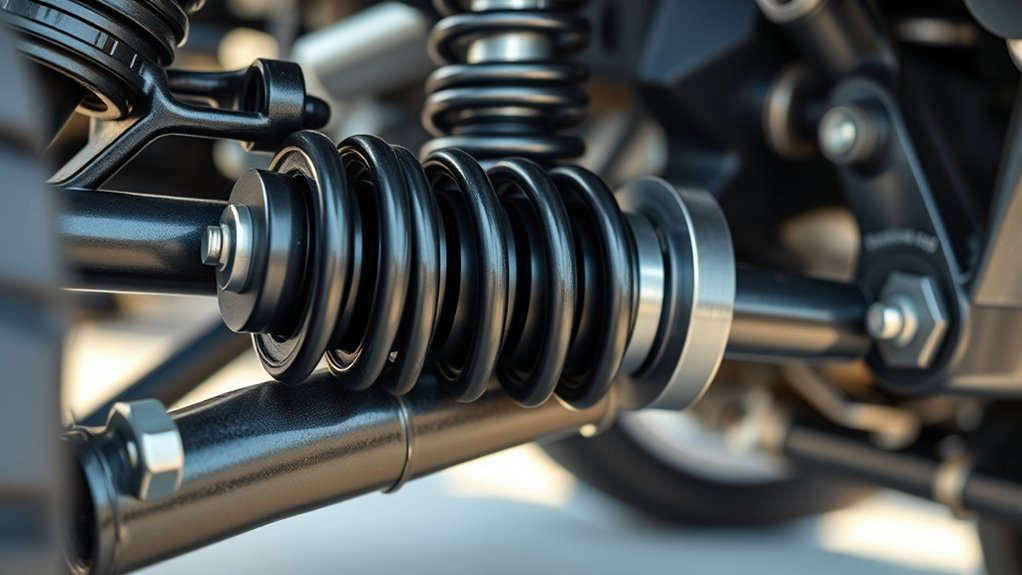
Springs absorb the initial impact from bumps, but shock absorbers control the energy those springs generate to keep your ride steady.
As key parts of the suspension, shock absorbers absorb and dampen the up-and-down motion by controlling hydraulic fluid flow inside their cylinders.
This reduces shock and prevents excessive bouncing, ensuring better tire-road contact and vehicle stability.
Neglecting maintenance can cause worn shocks, which may lead to poor handling and uneven tire wear.
| Type | Operation | Purpose |
|---|---|---|
| Twin-tube | Hydraulic fluid | Absorbs shocks |
| Monotube | Gas or hydraulic | Controls suspension |
| Single-acting | Compression | Dampens movement |
| Double-acting | Compression & expansion | Smooth ride |
Ball Joints and Knuckle Arms
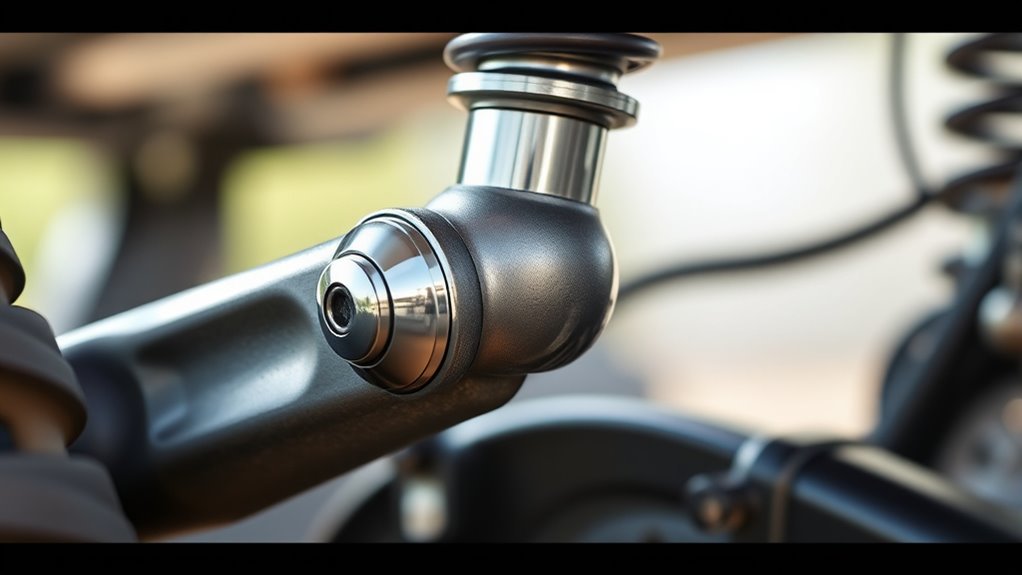
Ball joints connect the control arms to the knuckle arm, letting your wheels turn smoothly while supporting the vehicle’s weight.
The knuckle arms play a key role in steering by allowing the wheels to rotate around the spindle shaft.
Both parts are essential to your suspension system. They directly impact vehicle stability and handling.
To keep your suspension system in top shape, focus on these three things:
- Regular lubrication of ball joints to prevent wear and guarantee smooth movement.
- Watch for clunking noises, which often signal worn or damaged ball joints.
- Inspect knuckle arms for any signs of damage that could affect steering precision.
Addressing these helps maintain safe, stable driving.
Plus, it prolongs your suspension’s life!
Stabilizer Bars and Lateral Control Rods
Beyond the connection between ball joints and knuckle arms, your vehicle relies on stabilizer bars and lateral control rods to keep things steady.
Stabilizer bars, also called anti-roll bars, reduce body roll by counteracting centrifugal forces during turns, improving your car’s handling performance.
The thicker the stabilizer bars, the stiffer their response to body roll, enhancing suspension performance.
Meanwhile, lateral control rods secure the axle under lateral loads, maintaining axle stability and ensuring precise control, especially during sharp maneuvers.
Both components work together to keep your ride smooth and responsive.
To maintain peak suspension performance and prevent handling problems, regular maintenance and inspection of stabilizer bars and lateral control rods are essential.
Neglecting them can compromise your vehicle’s stability and safety on the road.
Upper and Lower Control Arms
While stabilizer bars manage body roll, upper and lower control arms play an important role in connecting your car’s chassis to the wheel hub assembly and maintaining proper wheel alignment.
These key suspension system components absorb shocks and impacts, guaranteeing stability and improving ride comfort.
The upper control arm mainly controls the wheel’s upward movement during compression, while the lower control arm handles both upward and downward motion.
Together, they help your wheels move independently, which is vital for smooth vehicle handling.
Here’s why they matter:
- They keep your wheel alignment precise, preventing uneven tire wear.
- They absorb road shocks, enhancing ride comfort.
- They maintain stability, improving overall vehicle handling and safety.
Regular checks guarantee your control arms support your driving experience effectively.
Strut Bars and Supporting Components
Because strut bars connect the strut towers in your car’s engine compartment, they strengthen the suspension system and reduce body roll during cornering.
Strut bars are made from lightweight materials like aluminum or steel, ensuring they add minimal weight while maximizing rigidity.
They work alongside other suspension components, such as control arms and shock absorbers, to enhance vehicle dynamics.
By reducing body roll, strut bars improve cornering performance, making your car more responsive and stable on the road.
Installing strut bars is a straightforward upgrade that can greatly boost how your suspension system handles tight turns and sudden maneuvers.
If you want better handling and a more connected driving experience, adding strut bars and supporting components is definitely worth considering.
Frequently Asked Questions
What Are the Most Common Suspension Problems?
The most common suspension problems you’ll face include broken springs causing sagging,
worn shock absorbers leading to poor handling, and damaged control arms creating vibrations.
Worn ball joints can also make clunking noises.
It’s important to get these checked promptly.
What Are the 5 Functions of a Suspension System?
Think of your suspension as your car’s personal bodyguard; it keeps you balanced, absorbs shocks, grips the road,
controls lean on turns, and protects your ride.
You’ll enjoy safer, smoother, and more stable driving every time.
What Are the Parts of a Suspension Called?
The main parts of a suspension system are springs, shock absorbers, control arms, ball joints, and struts.
Each part works together to keep your ride smooth, stable, and safe while you’re driving.
It’s interesting how these components all play a role in your vehicle’s performance, isn’t it?
What Are the Four Main Types of Suspension Systems?
You’ve got dependent, independent, semi-independent, and multi-link suspensions—basically, the car’s way of saying, “I’ll either tough it out, dance solo,
do a bit of both, or juggle arms like a circus pro for your comfort.”
Conclusion
Now that you’ve explored the key parts of a car suspension system, you can feel how each component dances together, cushioning every bump and curve.
Like a well-rehearsed symphony, springs bounce, shock absorbers steady, and control arms guide your ride smoothly down the road.
When you understand this intricate ballet beneath your wheels, you’re not just driving—you’re gliding on a carefully crafted rhythm.
This rhythm turns every journey into a seamless adventure.
In conclusion, knowing the essential parts of your car’s suspension—like springs, shock absorbers, and control arms—enhances your driving experience.
It’s not just about getting from point A to point B; it’s about how smoothly and comfortably you travel.
So next time you hit the road, appreciate the suspension system’s role in making each ride a delightful experience.