Why Is a Fifth Wheel Called a Fifth Wheel
You call it a fifth wheel because early carriages had an extra horizontal wheel beyond the main four that helped with steering and stability.
This additional “fifth” wheel acted as a pivot point, improving control when towing heavy loads.
Over time, this idea evolved into the modern fifth wheel hitch you see on semi-trucks and RVs.
These hitches provide better weight distribution and safer towing.
Keep exploring, and you’ll discover how this simple concept transformed towing technology.
Key Takeaways
- The term “fifth wheel” originated from an additional horizontal wheel used on early carriages to improve steering and stability.
- It refers to an extra connection point beyond the traditional four wheels on a vehicle.
- The fifth wheel served as a pivot for better maneuverability when towing heavy loads.
- It evolved into a specialized hitch mounted above the truck’s rear axle for trailers.
- The name reflects its original function as an added wheel-like component aiding control and balance.
Origin of the Term “Fifth Wheel”

Although you might hear “fifth wheel” mostly in modern towing contexts, the term actually comes from early carriages and wagons.
Back then, the fifth wheel was a horizontal, circular device placed over the front axle, allowing the front wheels to pivot smoothly.
This design gave better steering control and stability when towing heavy loads.
The name “fifth wheel” reflects its role as an extra connection point, enhancing the hitch setup beyond just the four wheels on the vehicle.
Today, the fifth wheel has evolved into a specialized hitch used to attach trailers, especially for RVs and semi-trucks.
When you use a fifth wheel hitch, you’re relying on that same principle of stability and articulation that made early wagons easier to tow.
Historical Context of the Fifth Wheel Hitch
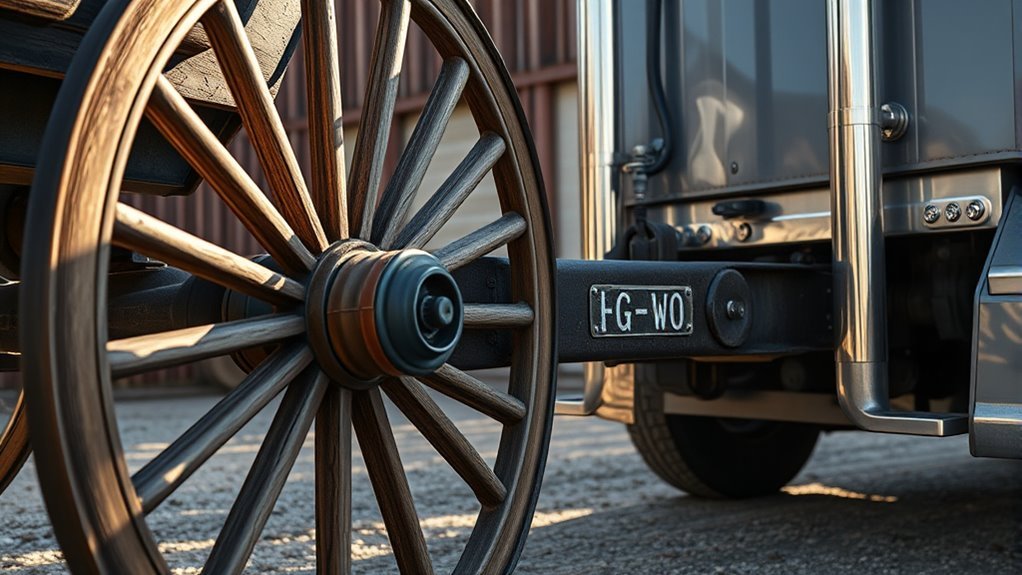
The fifth wheel’s origins in early carriages set the stage for its role in modern towing systems.
In historical contexts, it served as a pivot point over the front axle, enabling better maneuverability.
Today’s fifth wheel hitch builds on this design, allowing you to tow a large trailer with enhanced stability and increased towing capacity.
Understanding this evolution highlights why the fifth wheel hitch remains essential in commercial trucking and RV use.
| Era | Function |
|---|---|
| Early Carriages | Pivot for front wheels |
| 1900s Wagons | Stable articulation point |
| Mid-20th Century | Adapted for heavier loads |
| Modern Trucks | Increased towing capacity |
| RVs | Secure large trailer towing |
Mechanical Function of a Fifth Wheel
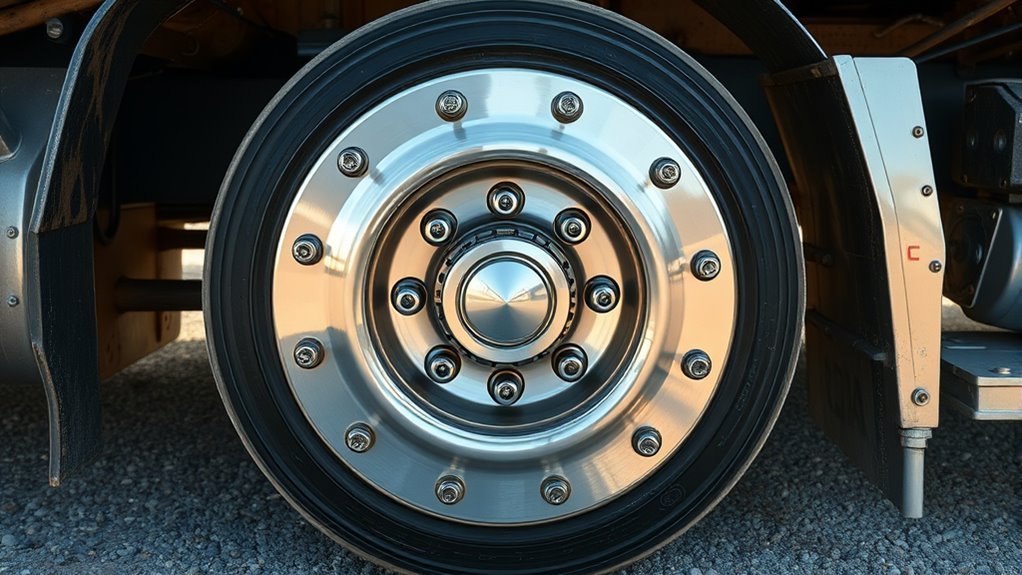
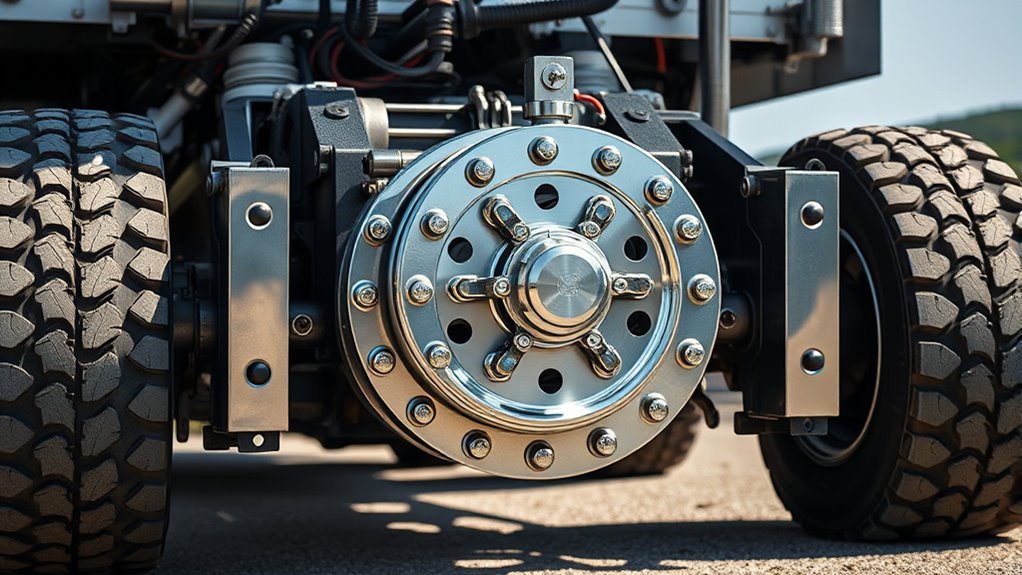
One key component you’ll find on a semi-truck is the fifth wheel, a horseshoe-shaped coupling device mounted above the rear axle.
This hitch system connects the trailer’s kingpin securely to the truck, allowing you to maneuver tight turns safely.
The fifth wheel’s locking mechanism firmly holds the kingpin in place, preventing detachment during transit.
It also plays an essential role in distributing the weight of the trailer evenly across both the tractor and trailer, which helps maintain balance and stability.
Some fifth wheels are fixed, while others slide to adjust load distribution based on trailer size.
By reducing friction between the kingpin and the fifth wheel with grease, the system operates smoothly and lasts longer.
This ensures reliable performance every time you hit the road.
Differences Between Fifth Wheel and Other Hitches
When you compare a fifth wheel to a traditional ball hitch, you’ll notice key differences in stability and weight distribution.
Fifth wheels mount in the truck bed and connect above the axle, offering better balance and control.
This setup makes towing larger trailers smoother and safer than with a standard bumper-pull hitch.
Fifth Wheel vs. Ball Hitch
Although both fifth wheel and ball hitches connect trailers to vehicles, they serve very different purposes and offer distinct advantages.
A fifth wheel trailer uses a U-shaped type of hitch mounted in the bed of a pickup truck, designed to handle larger and heavier loads. This setup provides better control and maneuverability, especially when maneuvering tight turns.
In contrast, a ball hitch is a spherical coupling mounted below the bumper and works well for lighter trailers. You’ll find ball hitches easier to install and compatible with more vehicle types, like SUVs or vans.
However, if you’re towing substantial weight, the fifth wheel hitch on your pickup truck offers a more secure and stable connection.
This makes it the preferred choice for heavy-duty towing.
Stability and Weight Distribution
Fifth wheel hitches offer unmatched stability by distributing your trailer’s weight directly over your truck’s rear axle. This greatly reduces sway compared to traditional bumper-pull hitches.
This weight distribution improves your towing dynamics by lowering the center of gravity and enhancing control.
The fifth wheel’s horseshoe-shaped design allows for greater articulation, letting you make sharper turns while keeping the trailer stable.
Whether you choose a fixed or sliding fifth wheel, you benefit from consistent or adjustable weight distribution tailored to your load. This ensures safer towing.
Plus, fifth wheels handle heavier loads—often between 15,000 to 30,000 pounds—making them ideal if you tow larger trailers.
Applications of the Fifth Wheel in Semi Trucks
Since you rely on semi trucks to transport heavy loads efficiently, understanding the fifth wheel’s role is vital.
The fifth wheel is the essential connection between the truck and trailer, allowing the trailer to pivot while the truck stays stable. It helps you tow heavy freight safely by distributing weight evenly, preventing damage or accidents.
Whether fixed or sliding, the fifth wheel adapts to your load needs. Greasing the fifth wheel reduces friction, extending its lifespan and ensuring smooth turns.
Key applications of the fifth wheel in semi trucks include:
- Securely linking tractor and trailer for articulation.
- Distributing freight weight for balanced hauling.
- Allowing safe and precise steering of towed loads.
- Providing flexibility with fixed or sliding options.
Evolution of Fifth Wheel Designs and Technology
You might not realize it, but the fifth wheel started as a simple mechanical solution on early carriages to improve turning.
Today, its design has evolved with innovations like sliding mechanisms and advanced locking systems that boost safety and stability.
Understanding this evolution helps you appreciate how technology continues to enhance towing performance.
Historical Mechanical Origins
Although you might not realize it, the concept behind the fifth wheel dates back to early carriages and wagons.
Back then, a horizontal, circular device allowed the front wheels to pivot smoothly.
This mechanical origin feature served as a crucial connection point over the front axle, enhancing maneuverability by enabling pivoting.
As loads grew heavier, the fifth wheel evolved from simple circular plates to the horseshoe-shaped coupling we use today.
This new design locks the trailer’s kingpin securely, ensuring safety and stability.
You’ll find that lubrication systems later improved its efficiency by reducing friction and extending lifespan.
Here’s a quick look at the historical mechanical origins:
- Early circular designs enabled smooth pivoting of front wheels.
- Positioned as a crucial connection point over the axle.
- Adapted over time for heavier loads and better weight distribution.
- Evolved into the modern locking mechanism securing trailers safely.
Modern Fifth Wheel Innovations
As fifth wheel technology has advanced, manufacturers have introduced lightweight materials and smarter designs that make towing safer and more efficient.
You’ll notice modern fifth wheel designs often use lightweight materials, reducing strain on your vehicle and improving fuel efficiency.
Advanced locking mechanisms guarantee your trailer stays securely attached, while user-friendly setups simplify hitching and unhitching.
Adjustable height options help you match your truck bed perfectly, enhancing weight distribution.
| Feature | Benefit |
|---|---|
| Lightweight Materials | Easier handling, better mileage |
| Advanced Locking | Increased reliability and safety |
| Adjustable Height | Better fit and balance |
| User-Friendly Setups | Faster, simpler connections |
These innovations make towing more accessible and efficient for you on every trip.
Technological Impact on Safety
When towing a fifth wheel, safety depends heavily on the design and technology behind your hitch.
Over time, fifth wheel RVs and their hitches in the truck have benefited from significant technological advancements that boost safety and reliability.
You’ll notice features like:
- Advanced locking mechanisms that prevent accidental uncoupling
- Built-in shock absorption systems to minimize sway and improve stability
- Sliding fifth wheels for better weight distribution and reduced axle stress
- Electronic braking systems integrated into trailers for enhanced stopping power
These innovations make your towing experience safer by improving how the fifth wheel RV connects, handles, and stops.
Frequently Asked Questions
What Does Fifth Wheel Mean in Slang?
In slang, a fifth wheel means you feel unnecessary or out of place, like you don’t really belong in the group.
You’re basically extra, just tagging along without adding much to the situation.
Can You Live in a Fifth Wheel Year Round?
You can live in a fifth wheel year-round, like nesting in a cozy, mobile cocoon.
Just guarantee your rig is well-insulated, equipped, and maintained, so you stay comfortable through every season’s changing dance.
With the right preparations, you can enjoy the freedom and flexibility of living on the road regardless of the weather.
Embrace the adventure!
Can a Regular Truck Pull a Fifth Wheel?
Yes, you can pull a fifth wheel with a regular truck if it has the right towing capacity and a fifth wheel hitch.
Make sure your truck meets weight requirements to tow safely and maintain control on the road.
What Are the Disadvantages of a Fifth Wheel?
You’ll face a learning curve since fifth wheels can weigh over 20,000 pounds, making them harder to maneuver.
Plus, they’re costly—often $40,000 to $130,000—and require a large truck, limiting your vehicle options.
Conclusion
Now that you’ve rolled through the history and mechanics of the fifth wheel,
you see it’s more than just a hitch—it’s the unsung hero linking trailers to trucks.
Think of it like a trusty bridge connecting two worlds.
Understanding why it’s called a “fifth wheel” helps you appreciate its unique role in hauling heavy loads.
So, next time you spot a semi, remember: that fifth wheel is the pivot point keeping everything in perfect sync.
This ingenious design allows for greater maneuverability and stability when towing.
It’s essential for hauling larger trailers, making long-distance travel smoother and more efficient.
In short, the fifth wheel truly deserves recognition for its vital contribution to the trucking industry.
So, the next time you see a truck and trailer on the road, think about that fifth wheel and the way it keeps everything aligned and in motion.