Is All Wheel Drive Good in Snow
If you’re driving in snow, all-wheel drive (AWD) can significantly enhance your traction.
By automatically distributing power to all four wheels, it helps you maintain control, especially in slippery conditions.
AWD is generally better than front-wheel or rear-wheel drive when navigating through light to moderate snow.
However, it’s important to remember that AWD alone isn’t a magic solution.
For real grip on icy roads, winter tires are essential.
They provide the necessary traction that AWD systems might not fully deliver on their own.
Additionally, understanding how to effectively use AWD modes can make a big difference.
In deeper snow, there may be situations where other drivetrains might be a better fit.
So, while AWD is a great asset in winter driving, it’s just one part of the equation for tackling snowy conditions safely.
Key Takeaways
- AWD improves traction by distributing power to all four wheels, enhancing control on snowy and icy roads.
- It performs better than FWD and RWD in light to moderate snow, but it’s less effective in deep, unplowed snow.
- Combining AWD with quality winter tires significantly boosts grip and safety in snowy conditions.
- Plus, AWD systems provide automatic power adjustment, which reduces wheel slip and improves stability without driver input.
- However, keep in mind that AWD alone does not guarantee safety. Proper tires and cautious driving remain essential in snow.
How AWD Enhances Traction in Snow
When you drive in snowy conditions, AWD automatically sends power to all four wheels. This gives you better traction on slippery surfaces like snow and ice.
The system adjusts torque between the front and rear wheels based on traction needs. This helps your vehicle maintain grip in challenging driving conditions.
AWD enhances control and performance, allowing you to navigate light to moderate snowfall without extra input. While AWD vehicles offer improved stability and handling on snow-covered roads, combining them with winter tires will further enhance traction and safety during severe winter weather.
Comparing AWD With Other Drivetrains for Winter
When you’re choosing a vehicle for winter, it’s important to understand how AWD stacks up against 4WD, FWD, and RWD.
AWD offers automatic power distribution for better grip in most snowy conditions.
On the other hand, 4WD excels in extreme, off-road winter terrain.
Let’s break down how each drivetrain performs so you can decide what fits your winter driving needs best.
AWD Vs 4WD
Although both AWD and 4WD enhance traction on snowy roads,
you’ll find that AWD systems automatically adjust power distribution for everyday winter driving.
In contrast, 4WD requires manual engagement and excels in more extreme conditions like deep snow or unplowed terrain.
When comparing AWD vs 4WD for winter conditions, each has strengths depending on your driving needs.
AWD provides better traction and helps you maintain control in light snow,
while 4WD delivers power to all four wheels for superior grip in extreme conditions.
| Feature | AWD |
|---|---|
| Traction on snowy roads | Automatic power distribution |
| Best for | Urban driving, light snow |
| Winter tires | Essential |
| Feature | 4WD |
| Traction on snowy roads | Manual engagement, full power |
| Best for | Deep snow, unplowed roads |
| Winter tires | Essential |
FWD and RWD Winter
Beyond AWD and 4WD, Front-Wheel Drive (FWD) and Rear-Wheel Drive (RWD) vehicles also face winter challenges worth considering.
FWD generally offers better traction in light snow because the engine’s weight rests over the driven wheels, improving control.
RWD, on the other hand, struggles more in snowy and icy conditions due to less favorable weight distribution, though winter tires can help boost performance.
AWD systems outperform both by automatically distributing power to all four wheels, enhancing traction and stability without driver input.
If you frequently encounter heavy snow or slippery terrain, AWD provides superior control and confidence.
However, if your winter driving is moderate, FWD combined with quality winter tires can suffice.
RWD is the least ideal for snow but can manage with careful driving and tire upgrades.
Why Winter Tires Are Essential Even With AWD
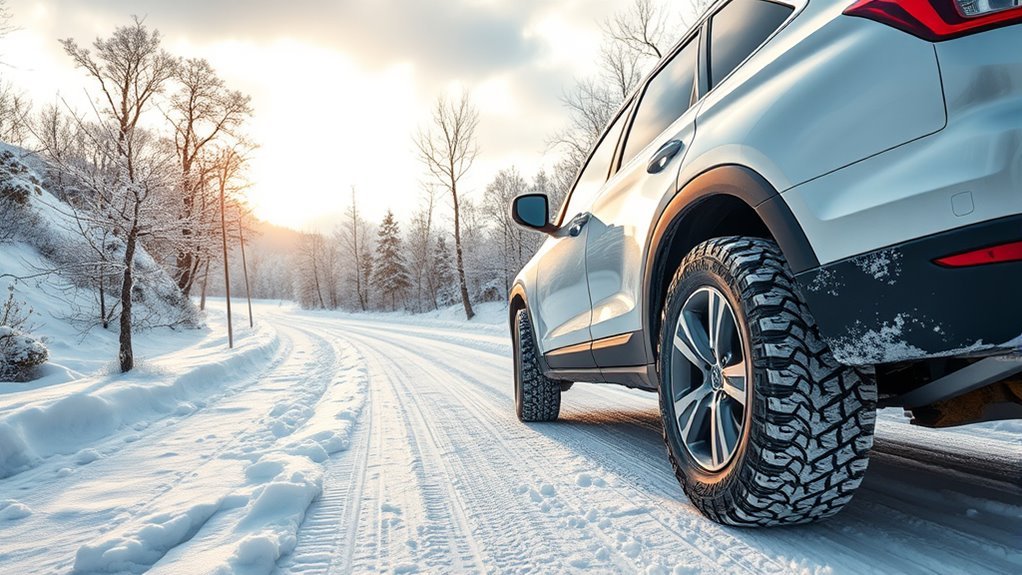
You might think AWD handles all your traction needs, but it only helps so much on slippery surfaces.
The real grip comes from your tires, and winter tires can make a huge difference in stopping distance and control.
To stay safe in snow and ice, you’ve got to rely on winter tires, not just your drivetrain.
AWD Limits Traction
Even with AWD, your vehicle’s traction in snow depends largely on the tires gripping the road.
AWD systems improve traction by sending power to the wheels with the most grip, but they can’t create traction where there’s none.
On icy roads or in deep snow, all-season tires often fail to maintain adequate grip, increasing your risk of loss of control.
Winter tires are designed specifically for these snowy conditions, enhancing vehicle control and overall performance by 25-50% compared to all-season tires.
Without winter tires, AWD can give you a false sense of security, compromising safety when you need it most.
Winter Tires Improve Safety
Although AWD boosts your vehicle’s ability to handle snow, winter tires play an important role in improving safety by providing superior grip and control.
Winter tires offer 25-50% better traction than all-season tires, thanks to their specialized tread rubber that stays flexible below 45°F.
This flexibility guarantees better contact with snowy and icy surfaces, considerably shortening stopping distances.
Even with AWD, your vehicle’s traction depends heavily on the tires, making winter tires vital for ideal performance and vehicle control during winter driving.
Installing four winter tires enhances stability and overall safety in snowy conditions, allowing you to maneuver confidently.
Relying solely on AWD without winter tires compromises safety, so equipping your car properly is the smartest choice for winter driving.
Best Practices for Driving AWD Vehicles in Snow
When driving an AWD vehicle in snow, equipping it with winter tires is crucial since they provide considerably better traction than all-season tires.
AWD systems automatically distribute power to wheels with the best grip, improving traction on snowy and icy roads.
AWD technology enhances safety by sending power to wheels with optimal grip on snow and ice.
To maintain control on slippery surfaces, regularly check tire pressure and verify tread depth stays above 4/32 inches.
Adjusting your driving to your vehicle’s AWD features, such as selecting “Snow” or “Lock” modes, can further improve traction.
Practice braking on slippery roads to understand how your AWD vehicle responds, helping you adapt to various driving needs.
When to Consider 4WD or FWD in Snowy Conditions
If you frequently drive in light to moderate snow, choosing between FWD and 4WD depends on the conditions you face and your vehicle’s capabilities.
FWD offers good traction on icy conditions and moderate snow, especially when paired with winter tires.
It’s ideal for urban settings where roads are regularly plowed.
However, if you often encounter deep snow, unplowed roads, or rural areas, 4WD is the better choice.
It delivers maximum grip and control by manually engaging all four wheels, making it perfect for challenging terrain.
AWD sits between these options, adjusting power automatically and working well in moderate snow.
Ultimately, match your drive system—FWD, AWD, or 4WD—with the winter conditions you regularly face to stay safe and maintain traction.
Maintenance Tips to Optimize AWD Performance in Winter
To keep your AWD system performing at its best during winter, you’ll need to stay on top of regular maintenance and vehicle checks.
Start by monitoring your tires—maintain proper pressure and verify all four have at least 4/32 inches of tread depth for ideal traction control in winter conditions.
Use the correct driving modes, like “Snow,” to adapt AWD performance to slippery roads.
Test your braking response in safe areas to familiarize yourself with your vehicle’s handling on low-grip surfaces.
Don’t forget routine maintenance on critical AWD components such as driveshafts and axles to prevent unexpected issues.
Keeping these aspects in check not only improves traction and safety but also helps maintain fuel efficiency throughout the cold months.
Frequently Asked Questions
What Is the Disadvantage of AWD?
You’ll face decreased fuel efficiency since AWD systems are heavier.
And you might get overconfident driving in snow.
Plus, if your tires aren’t winter-ready, AWD won’t help much with traction or handling in slippery conditions.
Is AWD or 4WD Better in Snow?
When traversing snowy roads, you’ll find 4WD offers a touch more confidence in deep, challenging conditions.
On the other hand, AWD smoothly manages lighter snow with ease.
Either way, equipping your vehicle with quality winter tires is essential.
Do I Need Snow Tires if I Have AWD?
Yes, you need snow tires even with AWD.
AWD helps control, but winter tires give you the traction and grip that AWD alone can’t provide.
Especially on icy or snowy roads, winter tires keep you safer in winter conditions.
Can an AWD Car Get Stuck in Snow?
Even the best sailors get caught in storms—yes, your AWD car can get stuck in snow, especially if tires lack grip or snow’s too deep.
Keep your tires sharp, or you’ll still be spinning wheels, stuck.
Conclusion
So, is all-wheel drive really good in snow?
Absolutely, it boosts your traction and control, making winter driving safer.
But remember, AWD isn’t a magic fix—you still need winter tires and smart driving habits to stay safe.
Knowing when to choose AWD, 4WD, or FWD can make all the difference.
Keep your vehicle well-maintained, and you’ll be ready to tackle snowy roads with confidence every winter.
In conclusion, all-wheel drive is a valuable feature for winter driving, enhancing your vehicle’s grip on slippery surfaces.
However, it’s crucial to complement AWD with quality winter tires and to practice safe driving techniques.
Ultimately, understanding the differences between AWD, 4WD, and FWD—and ensuring regular vehicle maintenance—will equip you better for snowy conditions, allowing for a more secure driving experience throughout the winter months.