How to Figure Wheel Backspacing
To figure wheel backspacing, it’s essential to get it right for proper wheel fitment.
Backspacing impacts tire clearance and suspension fit, making it crucial for vehicle performance.
To calculate the backspacing of your wheel, start by placing the wheel face down on a flat surface.
Next, measure from the hub mounting surface to the back edge of the rim.
Use a ruler or tape measure held perpendicular to ensure your measurement is accurate.
This distance, which is always a positive number, will help you determine if your wheels will fit without rubbing against the tires or suspension components.
Understanding your backspacing not only ensures a proper fit but also helps you make informed decisions about tire choices.
If you’re curious about how backspacing influences vehicle performance, there’s certainly more to explore!
Key Takeaways
- Place the wheel face down on a flat, level surface to ensure accurate measurement.
- Measure from the back of the wheel rim to the hub mounting surface using a tape measure or ruler.
- Use a straight edge or ruler perpendicular to the wheel to get an exact distance to the mounting face.
- Record the measurement in inches; this distance is the wheel’s backspacing.
- Compare your measurement with recommended backspacing values for your wheel size to ensure proper fitment.
Understanding Wheel Backspacing and Its Importance
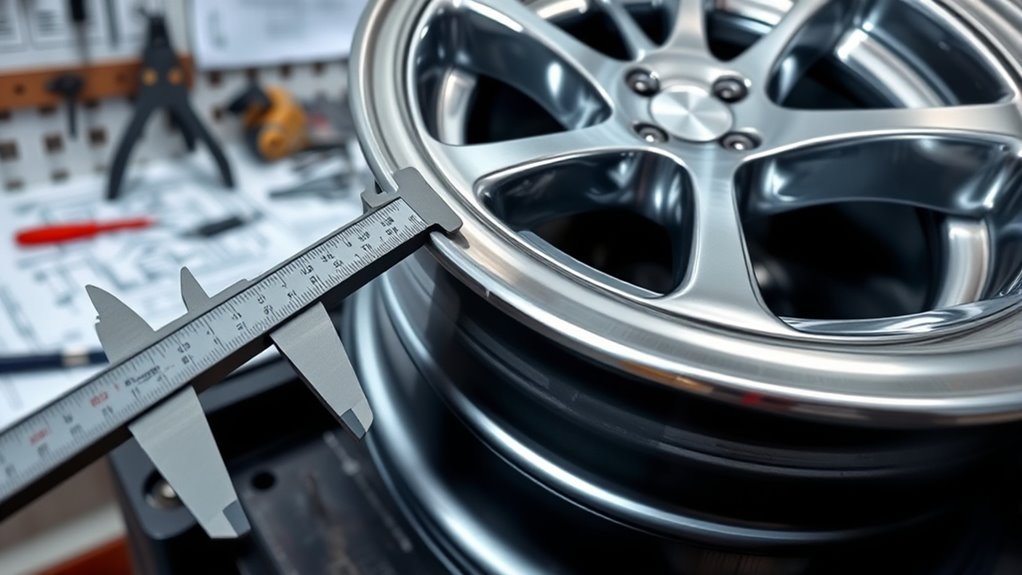
Although wheel backspacing might seem technical, understanding it is vital because it determines how your wheel fits relative to suspension parts.
Backspacing measures the distance from the back of the rim to the mounting face, ensuring enough clearance for suspension components.
Backspacing is the distance from the rim’s back to the mounting face, ensuring suspension clearance.
Unlike offset, which can be positive or negative and affects the wheel’s position within the wheel well, backspacing is always a positive value.
Most factory wheels have about 6.25 inches of backspacing as a baseline.
If you’re fitting wider tires, aiming for 4.5 to 4.75 inches helps prevent rubbing while maintaining proper fitment.
Adjusting backspacing influences your vehicle’s stance and ride quality, so getting it right is essential for peak performance and handling.
Tools Needed for Measuring Backspacing
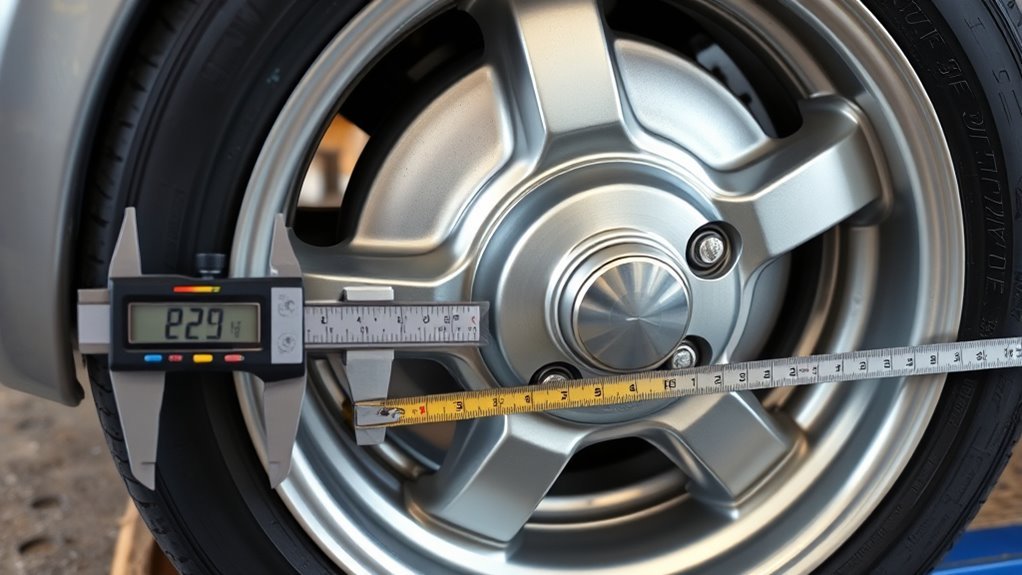
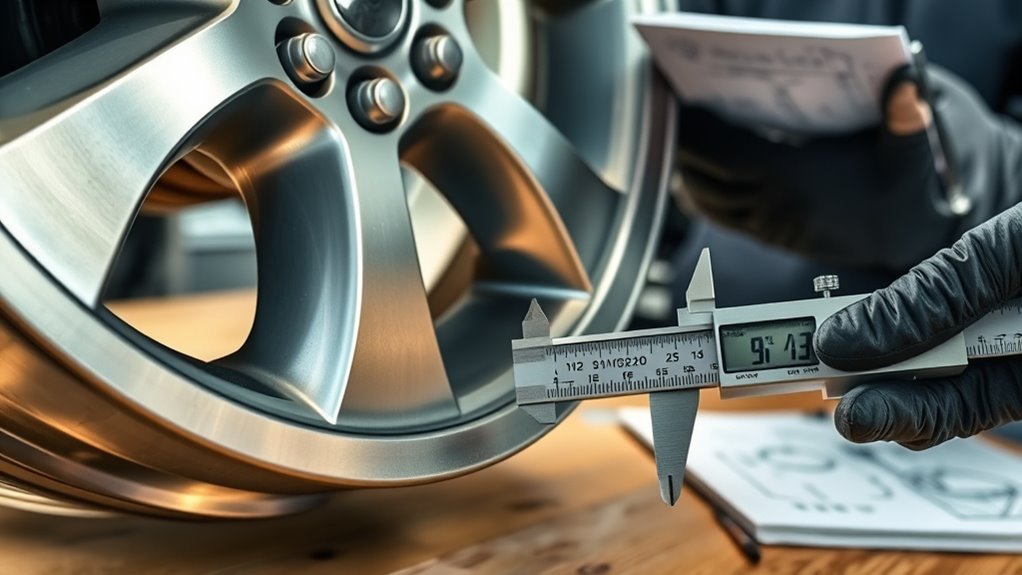
To measure backspacing accurately, you’ll need essential tools like a tape measure or caliper to get precise distances from the wheel rim to the mounting surface.
Using a level or straight edge helps guarantee your measurements stay straight and true.
These techniques keep your results reliable and make comparing wheels much easier.
Essential Measuring Tools
When you measure wheel backspacing, having the right tools makes all the difference.
Accurate measuring guarantees proper fitment and avoids costly mistakes. Here are the essential tools you’ll need:
- Tape measure – to measure backspacing precisely from the hub mounting surface to the wheel’s inner lip.
- Straight edge or ruler – to keep your measurements perpendicular for accuracy.
- Caliper – to check the wheel’s thickness, helping you assess fitment adjustments.
- Level – to confirm the wheel sits flat, preventing distorted measurements.
Don’t forget a notepad or digital device to record your measurements.
Using these tools will simplify measuring backspacing and improve your wheel fitment process.
Accurate Measurement Techniques
Since accurate backspacing measurements are vital for proper wheel fitment, you’ll want to use the right tools and techniques to get precise results.
Start by placing the wheel flat on a level surface to prevent any errors.
Use a straight edge or ruler to measure from the back lip of the wheel to the mounting surface where it attaches to the hub.
For even more accuracy, especially with complex or wide wheels, use calipers.
Always record your backspacing measurement in inches, reflecting the distance from the wheel’s back to the mounting face.
Double-check your measurements to avoid fitment issues, which is essential if your daily driver depends on proper wheel alignment.
These accurate measurement techniques guarantee your wheels fit perfectly and perform safely.
Step-by-Step Guide to Measuring Wheel Backspacing
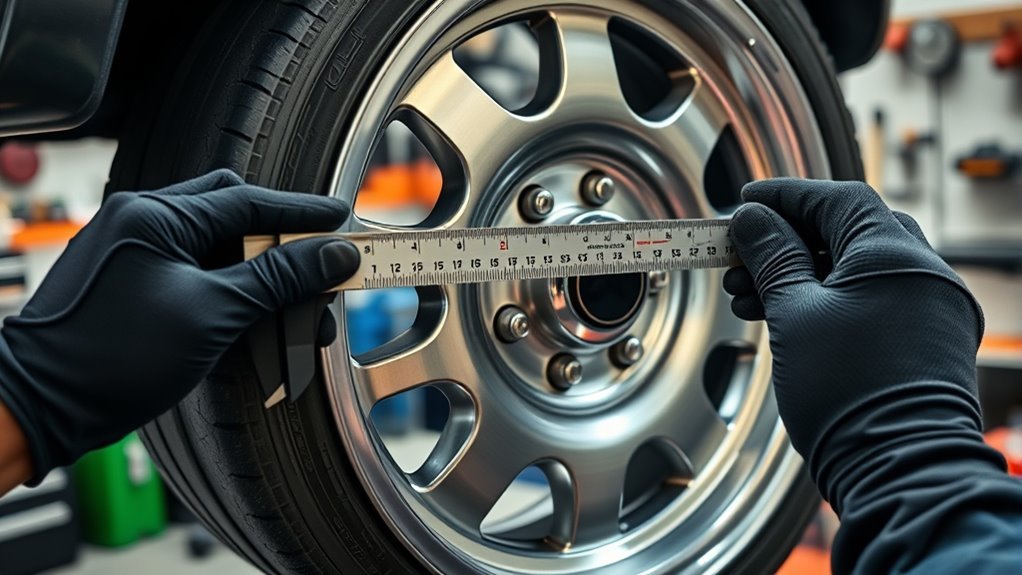
To measure wheel backspacing accurately, you’ll need a flat surface and a ruler or caliper.
Start by placing the wheel face down and measuring from the back of the rim to the hub mounting surface.
Following this simple procedure guarantees you get the precise measurement needed for proper fitment.
Tools Needed
Accurate wheel backspacing measurement requires just a few simple tools that you likely already have.
To guarantee you get the correct wheel offset and achieve the desired (positive) offset, make sure you gather the following:
- A straight edge or ruler – essential for measuring from the back of the wheel to the mounting surface.
- A flat surface – to lay the wheel on and avoid any distortion during measurement.
- A tape measure – handy for checking the overall wheel width.
- A notepad and pen – to record your measurements for comparison and fitment adjustments.
With these tools, you’re set to measure backspacing accurately.
This will help you achieve proper stance and clearance without rubbing suspension components.
Measuring Procedure
With your tools ready, you can begin measuring wheel backspacing by placing the wheel face down on a flat, stable surface.
Make certain the wheel is secure and won’t move during measurement.
Next, use a ruler or measuring tape to measure from the back edge of the wheel rim to the mounting surface where the wheel attaches to the hub.
If the wheel has a lip, measure directly to the back of that lip to avoid errors.
Record this distance in inches; this is your wheel’s backspacing.
Finally, compare your measured backspacing with the recommended value for your vehicle to guarantee proper fitment and clearance from suspension parts.
Accurate measurement helps avoid fitment issues and enhances safety.
Calculating Backspacing From Measurements
How do you calculate wheel backspacing from your measurements?
Start by measuring the distance from the back of the wheel to the mounting surface where it attaches to the hub. Use a precise tool to guarantee accuracy.
Then follow these steps:
Then follow these steps to accurately measure and calculate your wheel’s backspacing for optimal fitment.
- Measure the total width of the wheel.
- Measure the distance from the mounting surface to the back edge of the wheel.
- Confirm the backspacing is a positive value—this prevents interference with suspension or fender well.
- Compare your backspacing to the wheel’s width to check for proper fitment and vehicle stance.
Proper backspacing guarantees the wheel fits flush without rubbing, maintaining both safety and performance on your vehicle.
Common Backspacing Ranges for Different Wheel Sizes
Several common backspacing ranges exist for different wheel sizes, helping you choose the right fit for your vehicle.
For 17×9 wheels, backspacing typically falls between 4.5 and 4.75 inches, ensuring enough clearance and preventing rubbing.
If you’re working with 18×10 wheels, aim for around 5.75 to 6 inches to keep a flush fit without hitting suspension parts.
Wider tires like 35×12.5 usually pair well with backspacing from 4.5 to 4.75 inches, avoiding contact with fender flares.
For smaller 15×8 wheels, backspacing of about 3.5 to 4 inches is common to maintain proper clearance from brakes.
Always base your backspacing on wheel width and your desired look, but don’t exceed recommended ranges to prevent fitment issues.
How Backspacing Affects Vehicle Fitment and Performance
Because backspacing directly affects where your wheels sit relative to the suspension and fenders, getting it right is essential for both fitment and performance.
Here’s how it impacts your vehicle:
- Proper backspacing prevents your wheels from rubbing against suspension components. This helps preserve handling and ride quality.
- For wider tires like 12.5 inches, a backspacing between 4.5 and 4.75 inches keeps tires clear of fenders and suspension.
- Increasing backspacing shifts the tire closer to the vehicle’s centerline. This can change track width and affect cornering stability.
- Too little backspacing (below 3.75 inches) pushes tires past fender flares. This can cause increased wear and potential handling problems.
Getting your backspacing right balances an aggressive stance with safe clearance. It improves both looks and performance!
Frequently Asked Questions
What Is 4.5 Backspacing on Wheels?
A 4.5-inch backspacing means the distance from the wheel’s mounting surface to the back edge of the rim is 4.5 inches.
This measurement is crucial for ensuring a balanced fitment.
You’ll also get proper clearance for wider tires without rubbing issues.
What Is the Offset for 7.5″ Backspacing?
With 7.5″ backspacing on a 7.5″ wide wheel, you’re looking at about a +70mm offset.
That means the hub sits closer to the wheel’s front, helping your wheels fit flush without rubbing.
What Is 4.25 Backspacing in Offset?
A 4.25-inch backspacing on a 9-inch wide wheel usually equals about a +0.25-inch offset.
You can calculate it by subtracting backspacing from half the wheel width, then converting to millimeters for precision.
What Offset Does 5.5″ Backspacing Equal?
If your wheel is 9.5 inches wide with 5.5 inches backspacing, you get zero offset.
For a 10-inch wide wheel, 5.5 inches backspacing equals about -0.5 inches offset, pushing the wheel outward.
Conclusion
Now that you know how to figure wheel backspacing, you’re basically a wheel-fitting wizard!
Getting this right isn’t just a small detail—it’s the difference between your ride looking like a sleek racecar or a clunky mess.
Don’t let improper backspacing ruin your vehicle’s performance or style.
With these simple steps, you’ll nail the perfect fit every time and turn heads wherever you go.
Your wheels will thank you, and so will your driving experience!
In conclusion, mastering wheel backspacing is essential for achieving that perfect look and performance.
Whether you’re aiming for style or functionality, the right backspacing can elevate your vehicle.
So, take the time to measure accurately and enjoy the transformation in your ride.
A well-fitted wheel not only enhances appearance but also contributes to better handling on the road. Happy driving!